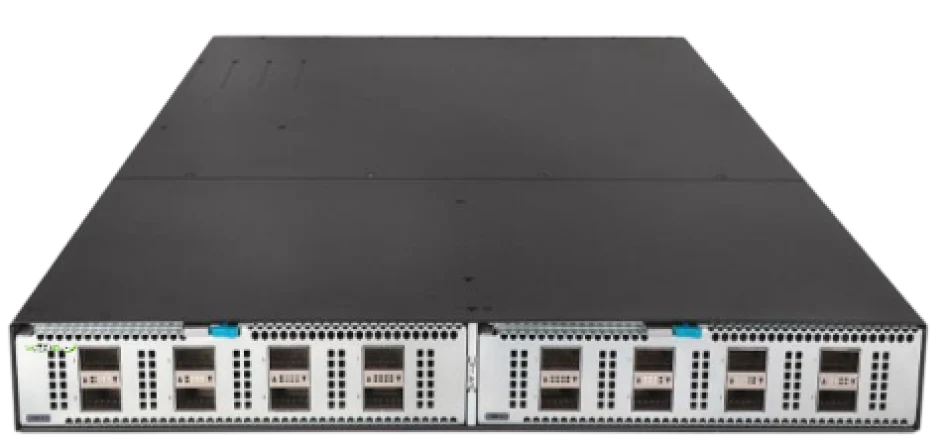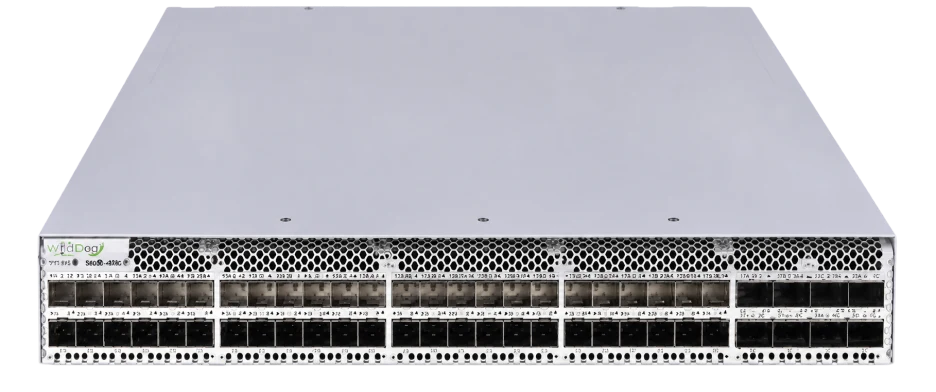
WD16000-F Series

WD16000-F High-End Routers

The WD16000-F is a high-end router series independently developed by Apollo Infoways Pvt Ltd. It utilizes distributed hardware forwarding and non-blocking switching technology. It adopts an advanced CLOS architecture with a separate control plane and forwarding plane, supporting high-density FE/GE, 10GE, 25GE, 40GE, 50GE, 100GE, and 400GE interfaces, with flexible single-slot performance expansion to meet different network position requirements.
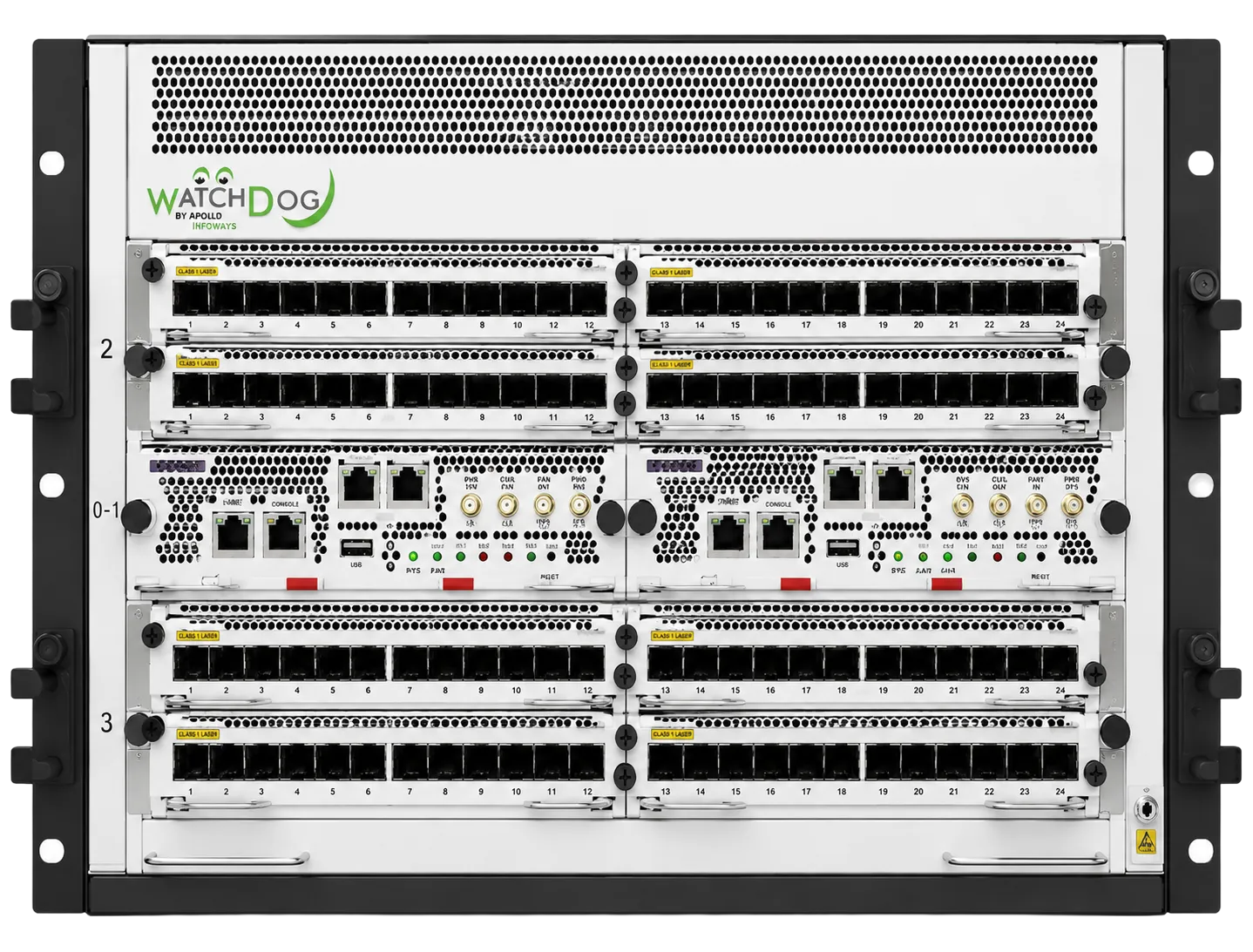
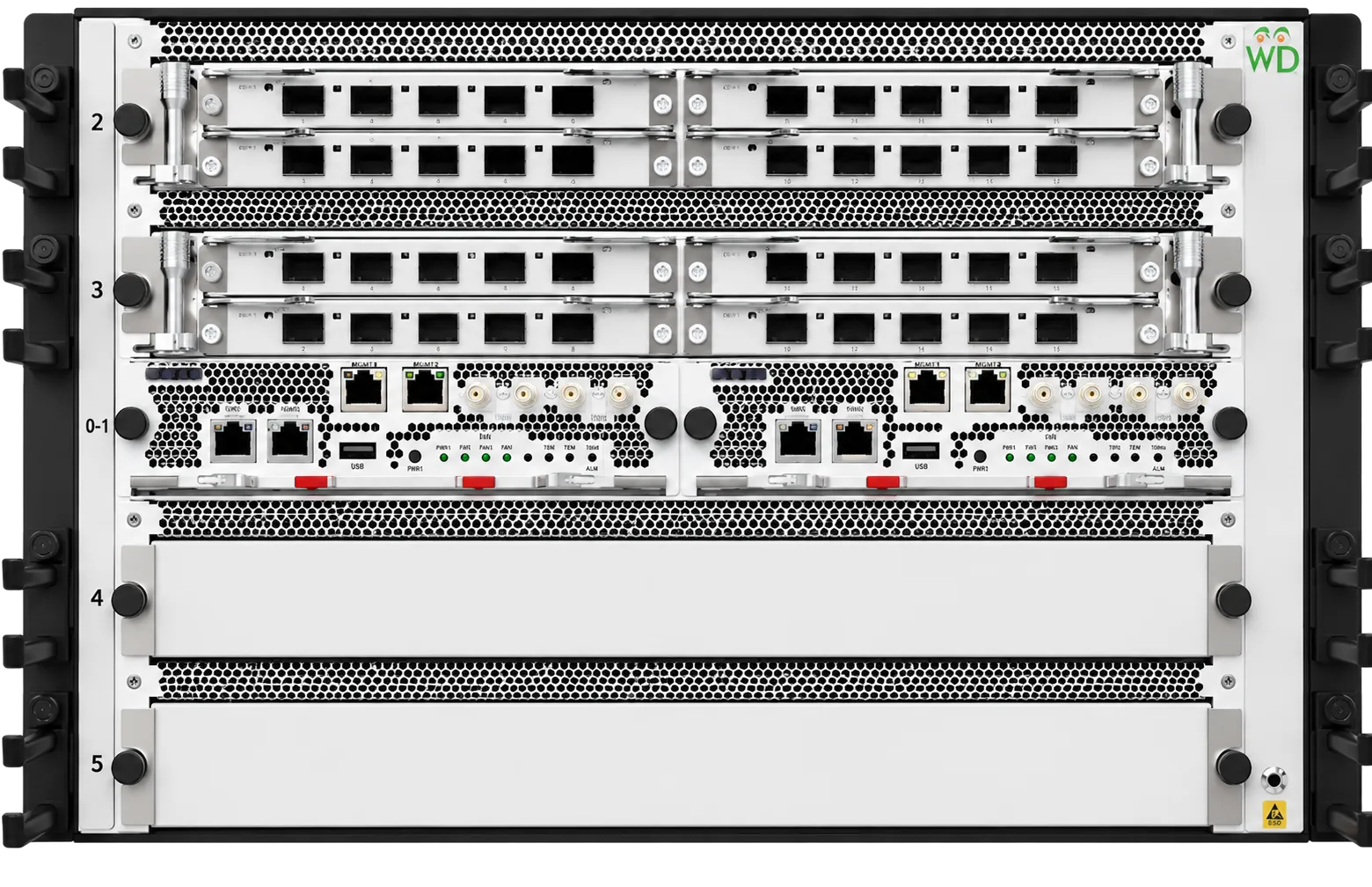
WD9800-48CD8D front panel

WD16003E-F

  • Switching Capacity: 6.4 Tbps
  • Forwarding Performance: 1,449.60 Mpps
  • Line Card Slots: 2
WD9800-48CD8D rear panel

WD16005E-F

  • Switching Capacity: 3.2T
  • Forwarding Performance: 724.80 Mpps
  • Line Card Slots: 4
WD9800-40B front panel

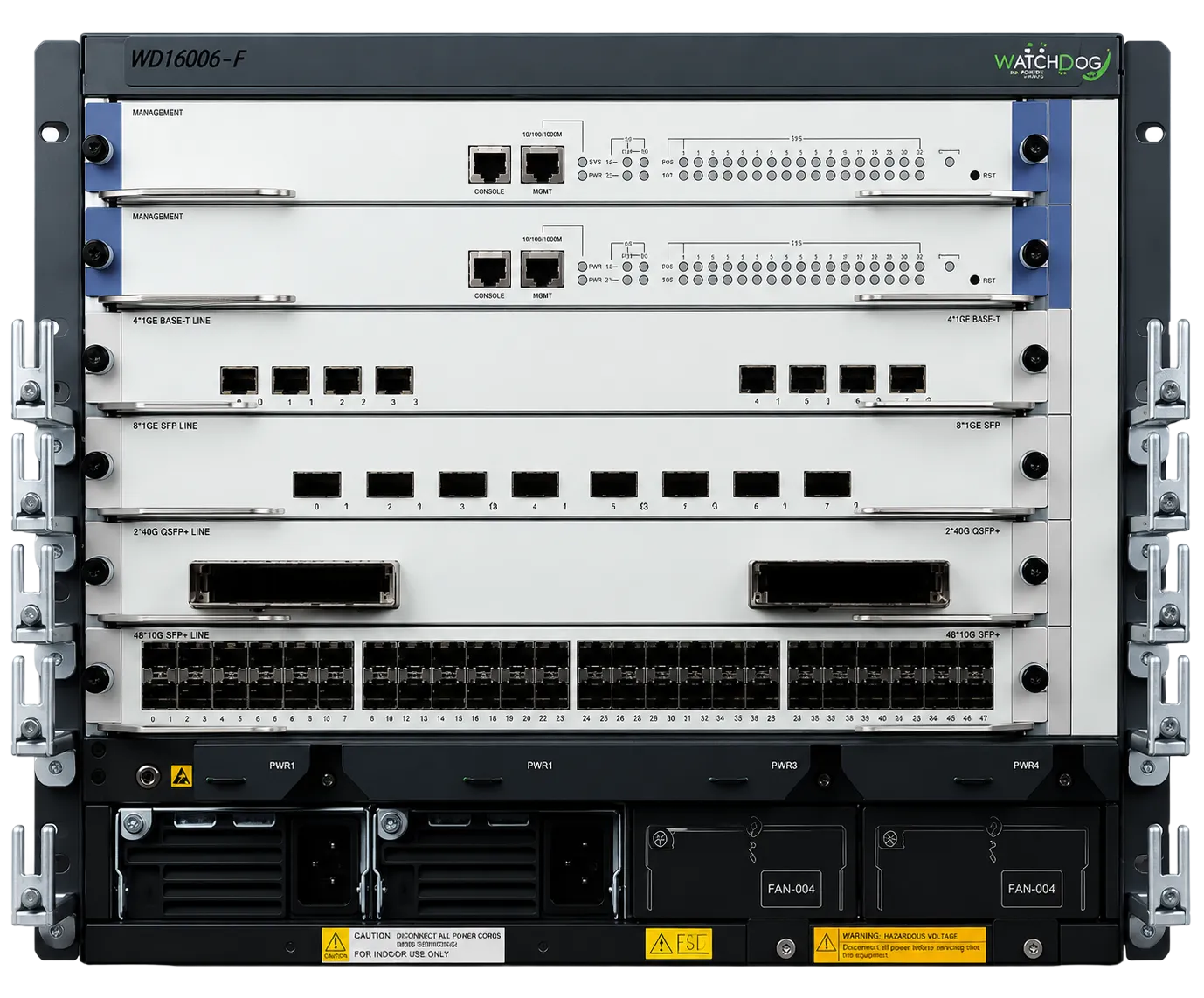
WD16006-F

  • Switching Capacity: 2.56T
  • Forwarding Performance: 579.84 Mpps
  • Line Card Slots: 4
WD9800-40B front panel

WD16018-F

  • Switching Capacity: 51.2T
  • Forwarding Performance: 11,596.80 Mpps
  • Line Card Slots: 16
WD9800-40B front panel

WD16010-F

  • Switching Capacity: 6.4T
  • Forwarding Performance: 1,449.60 Mpps
  • Line Card Slots: 8
WD9800-40B front panel

WD16010H-F

  • Switching Capacity: 25.6T
  • Forwarding Performance: 5,798.40 Mpps
  • Line Card Slots: 8

Key Features

Comprehensive SDN Capabilities

With the accelerated evolution of the intelligent era, enterprise services are becoming increasingly complex, diversified, and bandwidth-intensive. Traffic growth continues to surge, exposing the structural limitations of traditional wide area networks (WANs), including uncontrollable forwarding paths, limited service visibility, and operational complexity in maintenance and troubleshooting. To address these challenges, SDN and intelligent networking technologies must be introduced to enable unified resource orchestration, optimal resource utilization, automated service provisioning, rapid deployment, real-time service awareness, proactive adaptation, differentiated protection mechanisms, and end-to-end service visibility. The WD16000-F delivers the following capabilities: • Supports SR/SRv6 and EVPN technologies, simplifying network configuration while enabling deterministic, manageable, and fully controllable traffic paths. • Supports sub-interface slicing, FlexE, and other hard isolation technologies, reserving bandwidth resources and ensuring high reliability and strict SLA guarantees for high-priority services. • Supports In-band telemetry and Telemetry-based deep flow detection, enabling real-time network health monitoring and transforming reactive maintenance into predictive, proactive operations. • Supports NETCONF and YANG, providing standardized configuration APIs to enable full automation of network provisioning and accelerate device and service deployment. • Supports Policy-based traffic steering functionality, intelligently selecting tunnel paths based on service priority to achieve differentiated forwarding and optimized traffic engineering. • Supports EVPN/VXLAN, enabling remote MAC and routing information learning to implement scalable Layer 2 and Layer 3 VPN services over VXLAN architectures. When integrated with the SD-WAN controller, the WD16000-F enables comprehensive network management, control, and analytical visibility. In conjunction with SDN components, it supports centralized orchestration across single- domain, multi-domain, and cross-layer environments, delivering unified policy enforcement and end-to-end business automation across the wide area network.

Powerful BNG functions

Traditional SR routers carry telecom services such as Mobile, Business, and IPTV, and BNG serves as the access gateway for broadband network applications, performing user authentication and management. The WD16000-F combines SR and BNG functions, improving the efficiency of user network device utilization and saving user investment. It provides the following benefits: • Supports Application-aware accounting (AAA), which distinguishes business types by destination address, realizing billing, bandwidth control, and QoS for different types of user businesses, providing users with differentiated business operation solutions • Supports unified wired and wireless authentication, simplifying user management costs. It meets the needs of massive user terminal access through high-capacity BNG, while also meeting the mobility and seamless authentication needs of wireless terminals. • Supports BNG VSS hot backup, avoiding single point of failures while simplifying operations, maintenance, and management.

Mobile carrier network IP RAN

Traditional mobile operator base station backhaul networks are built on TDM/SDH. However, with the deployment and development of 3G and LTE services, data services have become the main carrier, and the demand for bandwidth is rapidly increasing. The traditional SDH TDM exclusive channel network expansion model is difficult to support, and the construction of a packetized backhaul network is an irreversible trend. IP RAN has become the mainstream solution in the mobile backhaul network field. The WD16000-F provides powerful functionality for IP RAN: • Supports various link detection and protection technologies, including: IP FRR, LDP FRR, Bypass PW, BFD For PW, and Y.1731. • Supports the 1588V2 clock synchronization protocol, achieving more accurate frequency synchronization and time synchronization. • Supports Ethernet clock synchronization, with clock recovery quality reaching 0.01 ppm

Software

SOFTWARE SPECIFICATIONS

Unicast Routing
  • IPv4/IPv6 Dual Stack Static Routing
  • RIP
  • RIPv2
  • RIPng
  • OSPF
  • OSPFv3
  • IS-IS
  • IS-ISv6
  • BGP
  • BGP4+ and MP-BGP
  • DHCP Server
  • DHCP Relay
  • VRRP
  • VRR
  • IPv6 Neighbor Discovery
  • PMTU Discovery
  • TCP6
  • Ping IPv6
  • Traceroute IPv6
  • Socket IPv6
  • Static IPv6 DNS
  • Specifying an IPv6 DNS Server
  • TFTP IPv6 Client
  • ICMPv6 MIB
  • UDP6 MIB
  • TCP6 MIB
  • IPv6 MIB
  • ECMP/UCMP
  • Policy-Based Routing
  • Routing Policies
  • Tunneling Technologies such as GRE
  • FRR for Static Routing
  • OSPF
  • IS-IS
  • BGP and OSPFv3
  • Filtering Routes Based on IP Address and AS Path
  • Route Tag
Multicast
  • Routing Protocols such as PIM-DM
  • MSDP, MBGP, and anycast-RP
  • MLD v1/v2
  • MLD Snooping v1
  • PIM-SM
  • PIM-SSM
  • IGMP Proxy
  • IGMP Snooping
  • PIM6-DM, PIM6-SM
  • PIM6-SSM
  • Multicast Policies
  • Multicast QoS
  • BIER
  • IGMP v1/v2/v3
  • IGMP Snooping v1/v2/v3
MPLS VPN
  • MPLS Label Distribution Protocols such as LDP
  • RSVP-TE
  • LDP Label Capacity Greater than 512K
  • Multi-Role Hosts
  • 6PE and 6vPE
  • Distributed Multicast VPN
  • Hierarchy of PE (HoPE)
  • P/PE functions, which comply with RFC2547bis Three inter-AS MPLS VPN methods (Option1/Option2/Option3)
  • BGP and LDP L2VPN, L3VPN, VPLS
  • Inter-AS L2VPN/L3VPN
  • MPLS TE FRR and LDP FRR
  • ACL-Based Traffic Identification
  • Redirection to Different VPNs
  • MPLS VPN Troubleshooting Features
  • MPLS Ping
  • MPLS Traceroute
  • L2VPN Access to L3VPN
  • VPLS Access in QinQ Mode
  • EVPN VPLS/VPWS/L3VPN
BNG Service
  • PPPoE
  • PPPoE over VLAN (PPPoEoVLAN)
  • PPPoE over QinQ (PPPoEoQ)
  • Access Authentication Methods
  • PPPoX Function
  • PPPoA
  • PPPoEoA Access Authentication Methods
  • Layer 2 Portal
  • Layer 3 Portal
  • Wireless Authentication for High-Capacity Massive User Access
  • IPoEoQ Access Authentication Methods
  • L2TP
  • Layer 2 Transparent Access
  • Layer 3 Transparent Access
  • Subnet/Interface/L2VPN-Leased Access Authentication Methods
  • Remote AAA Based on RADIUS/TACACS+
  • Bandwidth Control QoS
  • QinQ Portal Access Authentication Methods
  • Unified Wired Access
  • RADIUS
  • TACACS
  • COPS protocols
  • Application-aware accounting
  • differentiates services by destination addresses to perform accounting
  • BNG and meets the mobility requirements of wireless endpoints BNG IRF, which offers redundancy and simplifies Ops
  • IPoE
  • IPoEoVLAN
Value-added Services
  • IPsec on the following types of interfaces: high- speed link interfaces (FE, GE, 10-GE, 40-GE, 50-GE, 100-GE, 2.5G POS, and 10G POS)
  • 1588v2
  • interface, 155M ATM, 622M ATM, and E1/T1
  • low-speed link interfaces (155M POS, 622M POS, CPOS)
  • High-precision NAT: Carrier Grade NAT (CGN), Static NAT, Dynamic NAT, NAT44/NAT444, NAT64
Virtualization Features
  • Virtualization technology, which virtualizes multiple physical devices into a logical device, manages devices and forwarding entries on a unified interface, and supports multi-chassis link aggregation
ACL
  • IPv4/IPv6 standard ACLs and extended
  • Hardware ACLs
  • ACLs Layer 2/Layer 3/Layer 4-based
  • ACLs Ingress/Egress ACLs
QoS
  • Hierarchical Qos (HQoS) queue scheduling mechanisms such as PQ, WFQ, and CBWFQ
  • 5-level HQoS scheduling for granular service management
  • Traffic shaping
  • Support a minimum of 8 hardware queues per interface the system's ability to handle
  • 256,000 queues mean it can efficiently manage traffic loads and maintain performance.
  • Congestion avoidance technologies such as tail drop (TD)
  • Weighted Random Early
  • Detection (WRED) Priority marking/remarking
  • 802.1p, ToS, DSCP, and EXP priority mappings
Ethernet
  • 802.1Q VLAN
  • Ethernet Virtual Circuits (EVC)
  • Layer 2 Protocol Tunneling
  • 802.1Q VLAN Trunk
  • QinQ VLAN Encapsulation
  • IEEE 802.3d (STP)
  • IEEE 802.3w (RSTP)
  • IEEE 802.3s (MSTP)
  • IEEE 802.3ad (Link Aggregation)
  • Static Link Aggregation
  • Multi-Card Link Aggregation
  • MACsec
  • FlexE
  • Aggregation of Interfaces at Different Rates
  • Port Mirroring (SPAN/RSPAN)
  • Flow Mirroring
  • On-Demand Channelization (Slicing)
  • QinQ Termination
  • On-Demand Channelization
SDN
  • VXLAN Layer 2 Gateway, VXLAN
  • Layer 3 Gateway
  • EVPN VXLAN Layer 2 Gateway
  • EVPN VXLAN Layer 3 Gateway
  • APN6, Telemetry
  • Switchover to SRv6 BE Path upon SRv6 Policy Path Failure
  • EVPN E-tree over SRv6
  • EVPN VPLS over SRv6 Policy
  • SR-MPLS BE,
  • SR-MPLS TE
  • PCEP
  • Network Information Collection Protocols such as BGP-LS
  • NETCONF and YANG
  • SR-BE, SR-TE
  • SR Policy
  • SR TI-LFA/Anti-Micro-Loop
  • SRv6-BE, SRv6 TE Policy
  • Policy-Based Traffic Steering OpenFlow v1.3
  • BGP FlowSpec
  • SR-MPLS
  • TE Policy
  • Traffic Statistics
  • OSPFv3 over SRv6
  • IS-IS over SRv6
  • L2VPN over SRv6
  • EVPN VPWS over SRv6 Policy
  • EVPN VPLS over SRv6 Policy
  • Color-Based Traffic Steering
  • DSCP-Based Traffic Steering by SRv6-TE Policy
  • Collection Based on SR/SRv6 TE Policy Paths
  • 10 Layers of SIDs in the Header for SRv6 TE Policy without Affecting Forwarding Capabilities
  • Ping and Trace Based on SR BE
Availability
  • Redundant Backup for the Key Components
  • The MPUs, Switching Fabric Modules, Power Supplies, and Fans
  • MPU and LPU Separation
  • Module Plus Submodule Design
  • Passive Design for the Backplane to Prevent Single Point of Failure
  • Network Processor (NP) Architecture Design which Prevents Services from Affecting Forwarding Capabilities
  • Hot Swapping for All Components
  • Hot Swapping of Switching Fabric Modules without Removing Fan Modules
  • TI-LFA FRR for SRv6 with Switchover Time No Longer than 50 ms
  • Intelligent Fan Rotation Speed Tuning
  • Built-in DC and AC Power Supplies, Not Occupying Service Slots
  • Stateful Failover, NSF, NSR, and GR
  • IP Trunk, MP
  • Ethernet Interface Aggregation, IP/LDP/VPN/TE/VLL FRR
  • NSR for OSPF/OSPFv3/IS-IS/IS-ISv6/BGP/BGP4+/VRRP/IPv6 VRRP/PIM-SM/PIM-DM/LDP
  • MPLS L3VPN/6VPE/MPLS TE Primary/Secondary Switchover without Packet Loss
  • RFC2544, Supporting Automatic Packet Transmission to Detect Throughput, Delay, Jitter, and Packet Loss Rate of Links
  • PW Redundancy, MPLS/Ethernet OAM, Y.1731, Routing Protocol/Port/VLAN Damping, and Other Protection Mechanisms
  • Hardware-Based BFD Supporting Fast Failure Detection for Various Protocols (Minimum Packet Interval of 3.3 ms) with a Failover Time of Less Than 50 ms
  • BFD for VRRP, OSPF, IS-IS, BGP, LDP, TE, SR, VRRPv6, OSPFv3, IS-ISv6, BGP4+, and PW (VCCV)
  • Comprehensive FRR Features: IP/IPv6/LDP/TE/VPNv4/VPNv6 FRR with Service Switchover Time Less Than 50 ms and Network Availability of 99.999%
Network Flow Analysis
  • NetStream, which supports the v5/v8/v9 data export formats, sampling
  • Hardware-based network traffic application analysis
  • outbound directions of interfaces
  • IPv4/IPv6/MPLS traffic collection and analysis
  • Traffic collection and analysis in the inbound
  • Abnormal traffic detection and monitoring
  • flow statistics collection
  • Multiple log hosts
OAM
  • In-band telemetry, which can detect network failures in real time
  • troubleshoot the network failures
  • Implement Visible Management over Performance Data
  • Ethernet OAM (802.3ah, 802.1ag/Y.1731)
  • LLDP
  • TWAMP
  • MPLS OAM
  • VRRP
  • BFD for Eth-Trunk, Bit Error Detection
Security
  • Firewall Modules
  • High-Encryption Modules Supporting AES, DES, 3DES, MD5, and SHA1 Encryption Algorithms
  • AAA Security Authentication Protocols (e.g., RADIUS and TACACS+)
  • Security Authentication and Accounting with Primary-Secondary Redundancy
  • Secure Network Management through SNMPv3
  • RADIUS v1/v2/v3 Providing a Secure Encrypted Channel for User Login
  • Standard and Extended ACLs for Packet Filtering and Network Attack Prevention
  • PADI, DHCP, and Portal Attack Defense
  • Plaintext and MD5 Authentication for RIPv2, OSPF, IS-IS, BGP, OSPFv3, IS-ISv6, and BGP4+ with Keychain Support
  • Defense Against ARP, Unknown Multicast, Broadcast, Unknown Unicast, Local Subnet Route Scanning, TCP SYN, TTL 1, PADI, DHCP, Portal, and Protocol Packet Attacks
  • Unicast Reverse Path Forwarding (uRPF) to Prevent Source Address Spoofing Attacks
  • Control Plane Attack Defense
System Management
  • In-Band Management and Out-of-Band Management
  • CLI-Based Configuration through Console/AUX Modem/Telnet/SSH2.0
  • File Upload/Download through FTP, TFTP, XMODEM, and SFTP
  • Groups 1, 2, 3, and 9
  • NTP Clock
  • Network Quality Analyzer (NQA)
  • Failure Alarms and Automatic Recovery
  • DHCP, uRPF
  • Data Logs
  • ICMP Syslog
  • Traceroute
  • Multi-Threaded Access to Devices through Telnet
  • Hot Patching to Achieve Smooth Software Upgrade
  • Support Debug, Alarms & Diagnostics
  • SNMP v1/v2c/v3
  • RMON v1/v2, Which Supports
Hardware

Hardware Specifications

Features WD16003E-F WD16006-F WD16005E-F WD16010-F WD16010E-F WD16010H-F WD16018-F
Switching Capacity 6.4T 2.56T 3.2T 6.4T 19.2T 25.6T 51.2T
Forwarding Performance 1,449.60 Mpps 579.84 Mpps 724.80 Mpps 1,449.60 Mpps 4,348.80 Mpps 5,798.40 Mpps 11,596.80 Mpps
Maximum Board Capacity 1.6T 320G 400G 400G 1.6T 1.6T 1.6T
DRAM/Flash 32GB/64GB Flash
MPU Slots 2 (1+1 redundancy) 2 (1+1 redundancy) 2 (1+1 redundancy) 2 (1+1 redundancy) 2 (1+1 redundancy) 2 (1+1 redundancy) 2 (1+1 redundancy)
Subcard Slots 8 16 16 32 32 32 64
Line Card Slots 2 4 4 8 8 8 16
Switch Fabric Modules 2 (1+1 redundancy) 4 (N+M redundancy) 2 (1+1 redundancy) 4 (N+M redundancy) 2+2 (N+M redundancy) 5 (N+M redundancy) 5 (N+M redundancy)
Total Number of Slots (LPUs + MPUs + Independent Switch Fabric Modules) 4 10 6 14 12 15 23
Chassis Integrated chassis, which can be installed in a 19-inch rack
Power Module System 4 × AC or DC power supplies (N+M redundancy) and built-in AC power supplies 4 × AC or DC power supplies (N+M redundancy) and built-in AC power supplies 4 × AC or DC power supplies (N+M redundancy) and built-in AC power supplies 6 × AC or DC power supplies (N+M redundancy) and built-in AC power supplies 6 × AC or DC power supplies (N+M redundancy) and built-in AC power supplies 8 × AC or DC power supplies (N+M redundancy) and built-in AC power supplies 16 × AC or DC power supplies (N+M redundancy) and built-in AC power supplies
Dimensions (H × W × D) 219 × 440 × 600 mm
(8.62 × 17.32 × 23.70 in) (5RU)
353 × 440 × 640 mm
(13.90 × 17.32 × 25.20 in) (8RU)
264 × 440 × 600 mm
(10.39 × 17.32 × 23.62 in) (6RU)
930 × 440 × 660 mm
(36.61 × 17.32 × 25.98 in) (21RU)
575 × 440 × 600 mm
(22.64 × 17.32 × 23.70 in) (13RU)
931 × 440 × 640 mm
(36.65 × 17.32 × 25.20 in) (21RU)
1687 × 440 × 640 mm
(66.42 × 17.32 × 25.98 in) (38RU)
Weight in Full Configuration <70 kg
(154.32 lb)
<85 kg
(187.39 lb)
<70 kg
(154.32 lb)
<154 kg
(339.51 lb)
<130 kg
(286.60 lb)
<165 kg
(363.76 lb)
<350 kg
(771.62 lb)
Operating Temp Operating temperature: -5 to 55℃
Interface Types E, GE, 10-GE (LAN/WAN), 25-GE, 40-GE, 50-GE, 100-GE, 400-GE, 155M POS, 622M POS, 2.5G POS, 10G POS, CPOS, 155M ATM, 622M ATM, E1/T1 400-GE to 100-GE interface switching 100- GE to 40-GE interface switching 155M POS, 622M POS, and GE interface switching ATM to POS interface switching 155M ATM to 622M ATM interface switching