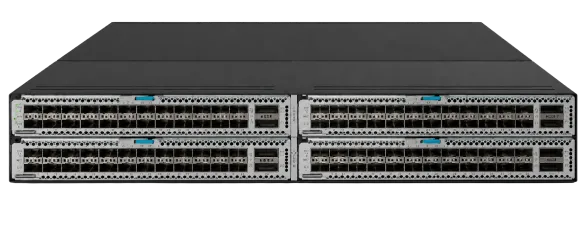
WD-DC-9600
- 4 × Interface Module Slots
- 2 × 1GE SFP management ports
- 2 × Out-of-Band Management ports (1 × RJ45, 1 × SFP)
- 1 × USB, 1 × Mini USB Console
- 650W AC or DC removable power modules and supports 2+2 power module redundancy.

The High-Density 400GE/100GE is a high-performance data center switch platform designed for next generation cloud and enterprise networks. It delivers wire-speed forwarding, ultra-low latency, and scalable fabric connectivity for demanding data center applications. The platform supports up to 32 × 100GE QSFP28 interfaces with 100GE/40GE auto-sensing, and each port can be configured in breakout mode to provide 4 × 25GE or 4 × 10GE connectivity, enabling up to 128 × 25GE/10GE ports.
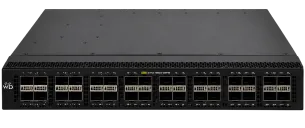
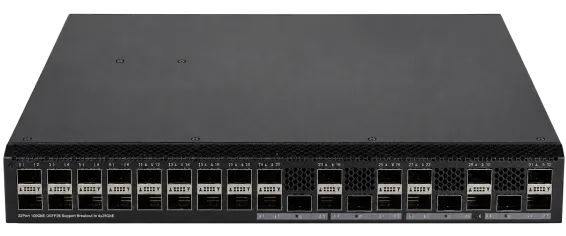
The switch offers high-density 400/100G/40G/25G/10G ports and a forwarding capacity as high as 6.4Tbps, which enables the switch to provide high-density server access in high-end data centers without oversubscriptions
Designed to meet the demands of modern data center switching architectures, the switch series supports advanced WatchDog Virtual Switching System (VSS) technology, enabling multiple physical switches to operate as a single logical device. This virtualization enhances network scalability, reliability, availability, and simplified management while providing a highly resilient infrastructure. VSS supports long-distance intelligent elastic architecture within a rack, across multiple racks, and even between geographically distributed locations. VSS stacking delivers convergence times of less than 50 milliseconds, ensuring rapid failover and minimal network disruption
WatchDog Data Center switches support VXLAN (Virtual Extensible LAN), enabling highly scalable Layer 2 network segmentation while improving utilization of available network paths. VXLAN allows seamless network expansion without the limitations of traditional VLANs. The switches also support MP-BGP EVPN (Multiprotocol Border Gateway Protocol Ethernet VPN), which acts as the VXLAN control plane. This simplifies VXLAN deployment, eliminates unnecessary traffic flooding, and reduces full-mesh requirements between VTEPs through the use of BGP Route Reflectors. For converged network environments, WatchDog Data Center switches support Fiber Channel over Ethernet (FCoE), allowing storage, data, and computing traffic to share a single unified network. This convergence significantly reduces network infrastructure complexity and overall construction and maintenance costs. In addition, the switches support Data Center Bridging (DCB) technologies, including Priority-based Flow Control (PFC), Enhanced Transmission Selection (ETS), and Data Center Bridging Exchange (DCBX). These capabilities ensure low latency and near-zero packet loss for Fibre Channel storage, RDMA workloads, and high- performance computing applications.
As data centres continue to grow in scale and complexity, reliability and operation and maintenance (O&M) have become key challenges to further expansion. WatchDog Data Center switches align with the trend toward automated O&M and data center visualization, enabling intelligent, transparent, and efficient network operations. The switches support Inband Network Telemetry (INT), an advanced monitoring technology that continuously collects device and network data with a single configuration. Compared to traditional query-based monitoring, INT significantly reduces device processing overhead while providing real-time visibility into timestamps, device IDs, port status, and buffer utilization. INT is supported across IP, EVPN, and VXLAN network environments. To provide comprehensive traffic insight, WatchDog Data Center switches offer multiple traffic monitoring and analytics tools, including sFlow, NetStream, SPAN/RSPAN/ERSPAN, and port mirroring. These capabilities enable precise traffic analysis, application visibility, network health assessment, traffic engineering, and optimized resource utilization. In addition, the switches support real-time monitoring of buffers and port queues, enabling dynamic and visualized network optimization. Precision Time Protocol (PTP) is also supported to deliver highly accurate clock synchronization for time-sensitive data center applications.
| Features | WD-DC-9600 | WD-DC-32QF | WD-DC-16H4QDF |
|---|---|---|---|
| Mini USB console port | 1 | 1 | - |
| USB port | 1 | 1 | 1 |
| QSFP-DD port | 4 (max) | ||
| QSFP28/QSFP+ | / | 32 | 32 (max) |
| SFP port | 2 | 2 | - |
| Expansion slot | 4 | - | - |
| CPU | WD-DC-9600: 4 cores, 2.2 GHz | WD-DC-32QF-A: 4 cores, 2.4GHz WD-DC-32QF-H: 4 cores, 2.2GHz |
WD-DC-16H4QDF: 2 cores, 2.2 GHz |
| Flash | 8 GB ( Premium 32 GB / 64 GB) | WD-DC-32QF-A: 4GB( Premium: 32 GB
/ 64 GB) WD-DC-32QF-H: 8 GB ( Premium: 32 GB / 64 GB) |
2 GB( Premium: 32 GB/64 GB) |
| SDRAM | 8 GB( Premium 16GB / 32 GB) | WD-DC-32QF-A: 8GB
(Premium:16GB /
32GB) WD-DC-32QF-H: 8 GB (Premium 16GB / 32 GB) |
4GB( Premium: 16GB/32 GB) |
| Latency | < 1µs (64-byte) | < 1µs (64-byte) | 25GE < 3 µs (64 byte) 100GE < 1.2 µs (64 byte) |
| Switching capacity | 6.4 Tbps | 6.4 Tbps | 6.4 Tbps |
| Forwarding capacity | 4122 Mpps | 4122 Mpps | 4122 Mpps |
| Buffer | 32 M | 32 M | 36 M |
| AC-input voltage | 90v to 264v | 90v to 264v | 90V~290V |
| DC-input voltage | –40v to –72v | –40v to –72v | -36V~-72V |
| Power module slot | 4 | 2 | 2 |
| Fan tray slot | 2 | 5 | 5 |
| Air flow direction | From front to rear or from rear to front | From front to rear or from rear to front | From front to rear or from rear to front |
| Typical power consumption | With four WDWM18CQ modules: 355 W
With four WDWM18CQMSEC modules:
443 W With four WDWM116Q modules: 311 W With four WDWM18QC modules: 251 W With four WDWM124XG2Q modules: 363 W With four WDWM124XGT2Q modules: 487 W With four WDWM124XG2QFC modules: 363 W With four WDWM124XG2QL modules: 275 W With four WDWM124TG2H modules: 355 W With four WDWM116FC modules: 311 W |
Single AC: 198 W Dual AC: 210 W Single DC: 197 W Dual DC: 208 W |
Single AC: 222W Dual AC: 227 W Single DC: 232W Dual DC: 234W |
| Maximum power consumption | With four WDWM18CQ modules: 688 W With four WDWM18CQMSEC modules: 748 W With four WDWM116Q modules: 616 W With four WDWM18QC modules: 496 W With four WDWM124XG2Q modules: 616 W With four WDWM124XGT2Q modules: 868 W With four WDWM124XG2QFC modules: 616 W With four WDWM124XG2QL modules: 520 W With four WDWM124TG2H modules: 688 W With four WDWM116FC modules: 616 W |
Single AC input: 376 W Dual AC inputs: 385 W Single DC input: 373 W Dual DC inputs: 377 W |
Single AC input: 400 W Dual AC inputs: 390 W Single DC input: 426 W Dual DC inputs: 414 W |
| Typical thermal consumption | With four WDWM18CQ modules: 1211 BTU/hr With four WDWM18CQMSEC modules: 1512 BTU/hr With four WDWM116Q modules: 1061 BTU/hr With four WDWM18QC modules: 856 BTU/hr With four WDWM124XG2Q modules: 1239 BTU/hr With four WDWM124XGT2Q modules: 1662 BTU/hr With four WDWM124XG2QFC modules: 1239 BTU/hr With four WDWM124XG2QL modules: 938 BTU/hr With four WDWM124TG2H modules: 1211 BTU/hr With four WDWM116FC modules: 1061 BTU/hr |
Single AC input: 676 BTU/hr Dual AC inputs: 717 BTU/hr Single DC input: 672 BTU/hr Dual DC inputs: 710 BTU/hr |
Single AC: 757 BTU/hr Dual AC: 775 BTU/hr Single DC: 792 BTU/hr Dual DC: 789 BTU/hr |
| MTBF (years) | 45.8 | 27.2 | 64.02 |
| MTTR (hour) | 1 | 1 | 1 |
| Operating temperature | -5°C to 55°C (32°F to 131°F) | -5°C to 55°C (32°F to 131°F) | -5°C to 55°C (32°F to 131°F) |
| Operating humidity | 5% to 95%, noncondensing | 5% to 95%, noncondensing | 5% to 95%, noncondensing |