
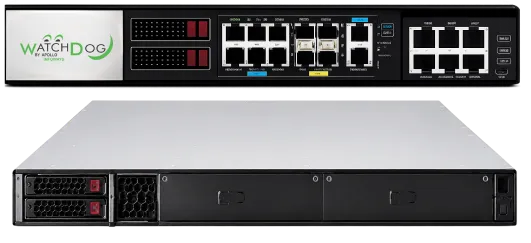
WD-AC1500
- Supports Up to 1,500 APs
- 20 Gbps Throughput
- Wi-Fi 6 & Wi-Fi 7 Support
- 8-Core High-Performance CPU
- Flexible Deployment
Key Features
WD AC with Powerful Capabilities
WD Wireless Controllers are purpose-built for demanding environments, delivering secure, highly resilient, and high- performance Wi-Fi connectivity that meets the rigorous requirements of enterprise-grade deployments. WD ACs support both Wi-Fi 6 and Wi-Fi 7 access points and can operate either as standalone units or in conjunction with the WD intelligent O&M platform. They integrate seamlessly with the WD cloud deployment platform and the WD-NMC on-premises platform, both offering automated management, AI-driven insights, and unified infrastructure control. With these flexible deployment options, organizations can efficiently manage the complete lifecycle of their Wi-Fi infrastructure, enhance operational efficiency, and address diverse enterprise application needs.
WD-AC1500 Key Features
The WD-AC1500 is a high-performance wireless controller with the ability to support up to 1500 access points and 15000 clients with up to 20 Gbps of maximum throughput. Additionally, it has 2 x SFP+ ports available to meet high throughput demands of 6GHz wireless networks. WD-AC1500 adopts the latest high performance multi-core CPU. WD-AC1500 CPU possesses 8 independent cores that can be virtualized to 32 logical cores, The strong computing power allows the devices to handle more users, more concurrent transactions, decrease latency in order to improve user experience
AP Management
In addition to 802.11a/b/g/n/ac/ax AP management, the WD-AC1500 can work together with WD 802.11be based APs to provide wireless access speed several times faster than a traditional 802.11a/b/g/n/ac/ax network. With 802.11be large proximity which makes WLAN multimedia applications deployment a reality.
SOFTWARE SPECIFICATIONS
Product Capabilities
- Basic information Support 802.11a/b/g/n/ac/ac Wave 2/ax/be
- AC Operating Mode AC Mode, managed by WD intelligent O&M platform
- Supported Wireless AP WD AP
- Number of managed APs by default 0
- Maximum number of access points 1500
- Maximum number of clients 15000
- Maximum throughput Up to 20 Gbps
- Maximum VLANs 4094
- Maximum MACs 15360
- Maximum AP Groups 512
- Maximum SSIDs 1500
- Maximum BSSIDs 12288
- Maximum static blacklists 15360
- Maximum whitelist 15360
- Maximum rules of ACL 15360
- Maximum DHCPv4 allocable Addresses 30720
- Maximum DHCPv6 allocable Addresses 30720
- Maximum Sessions 1536000
- Maximum NAT Sessions 1536000
Tunnel Management
- CAPWAP tunnel Unicast/broadcast/DNS/DHCP/static IP method for discovering AC
- NAT NAT between AC and AP
- DTLS Tunnel between AC and AP support DTLS encryption
- IPv4/IPv6 Tunnel between AC and AP support IPv4 and IPv6
- Time synchronization Synchronizing clock information from AC
- Dual tunnel Establishing CAPWAP tunnels with two ACs
WLAN Extension
- RF adjustment Automatic channel/power/bandwidth adjustment
- SSID hiding Restrict access and improve wireless network security by SSID hiding
- Limit the number of connected users User access count restriction based on SSID and RF
- Forwarding mode Centralized forwarding/local forwarding/policy forwarding
- Local forwarding Local forwarding based on SSID and VLAN
- VLAN binding Binding VLAN based on interface/SSID/MAC
- User isolation VLAN-based user isolation SID-based user isolation
- Load balancing Traffic-based load balancing User-based load balancing Frequency band-based load balancing, dual-5G devices only
- Band steering Help 6G capable clients migrate from 5G to 6G radios. Wi-Fi 6E and Wi-Fi 7 clients are automatically directed to the 6G radio to leverage its benefits, while freeing up 2.4G and 5G radios for legacy clients
- Roaming 802.11k and 802.11v smart roaming 802.11r fast transition roaming
- Multicast enhancement IPv4/IPv6 MLD Snooping/IGMP Snooping Convert multicast data into unicast data for transmission, reducing network congestion
- Wireless location Fit AP mode support BLE location Fit AP mode support RSSI location
- Mesh Mesh link Mesh link security Multi-hop Mesh
- Wireless probing Monitor the wireless network environment by monitoring wireless network messages
- Hotspot 2.0 Fit AP mode support Hotspot 2.0
- BYOD Identifies device types according to the OUI in the MAC address Identifies device types according to the user agent (UA) field in an HTTP packet Identifies device types according to DHCP Option information
- Bonjour gateway Forwarding mDNS packets across VLANs
User Authentication
- 802.1X authentication Local and remote 802.1X authentication
- MAC authentication Local and remote MAC authentication
- Portal authentication Local and remote Portal authentication Guest/Captive portal Portal mac-trigger
- WPA/WPA2 authentication and encryption WPA/WPA2-PSK+TKIP WPA/WPA2-PSK+CCMP WPA/WPA2-802.1X+TKIP WPA/WPA2-802.1X+CCMP WPA/WPA2-PSK+TKIP-CCMP WPA/WPA2-802.1X+TKIP-CCMP
- PPSK Fit AP mode support Private Pre-Shared Key, obtain passwords to access wireless networks through the WD intelligent O&M platform
- Social Media APPs Authentication Support Google/Facebook/Twitter through the WD intelligent O&M platform
- Encryption TKIP, CCMP WEP40, WEP104 WPA2-Personal (802.11i) WPA2-Enterprise with 802.1X WPA3-Personal, WPA3-Enterprise WPA3-Enhanced Open (OWE) Advanced Encryption Standard (AES)
- PSK Support PSK and Private-PSK Support Multiple SSIDs and multiple PSKs Each SSID use a unique PSK password
- Extensible Authentication Protocol (EAP) EAP-Transport Layer Security (EAP-TLS) EAP-Tunneled TLS (EAP-TTLS) Protected EAP (PEAP) v0 or EAP-MSCHAP v2 EAP-Challenge Handshake Authentication Protocol (EAP-CHAP) EAP-Subscriber Identity Module (EAP-SIM) EAP-Authentication and Key Agreement (EAP-AKA) PEAP v1 or EAP-Generic Token Card (EAP-GTC) EAP-Flexible Authentication via Secure Tunneling (EAP-FAST) EAP-MD5 Microsoft Challenge Handshake Authentication Protocol (MSCHAP) v2 EAP-Pre-Shared Key (EAP-PSK)
Wireless Security
- WIPS Wireless Intrusion Prevention System, protect the network from unauthorized access, such as Rogue AP, Rogue client, Rogue Wireless Bridge, Ad-hoc
- Forwarding security- Packet filtering MAC address filtering Broadcast storm suppression
- Wireless EAD Coupled with EAD (End user Admission Domination) solution, implement security policies for terminals accessing the network to improve wireless network security
- Management frame protection Provide management frame protection for wireless clients to enhance wireless network security
- IPSG IP source guard (IPSG) prevents spoofing attacks by using an IPSG binding table to filter out illegitimate packets
Layer 2 and Layer 3
- IP address configuration Static IP, DHCP assigned IP
- Ethernet Link aggregation, Port isolation, Loop detection, Port mirroring, Storm suppression
- DHCP DHCP server, DHCP Relay, DHCP Client, DHCP Snooping
- DNS DNS client, DNS proxy, DNS fast-reply, DNS Snooping
- VLAN Default VLAN, Port-based VLAN Access mode, trunk mode, and hybrid mode
- VLAN Pool A VLAN group supports adding multiple VLAN lists
- MAC Static MAC, Dnamic MAC, Blackhole MAC
- ARP Static ARP, Dynamic ARP, Gratuitous ARP Proxy ARP, ARP snooping, ARP fast-reply, ARP suppression
- NAT Static NAT, NAT66, NAT LOG
- LLDP Link Layer Discovery Protocol, discovering and identifying other LLDP enabled devices and neighboring devices in the network
- STP Spanning Tree Protocol STP, RSTP, PVST, MSTP
- IP routing Static routing, OSPFv2, Policy-based routing
- IP Multicast MLD Snooping, IGMP Snooping
- ACL Basic ACL, Advanced ACL, Layer 2 ACL
- QoS Qos policy, Priority mapping, Traffic policing, Priority marking
- VPN Gre, L2TP, SSL VPN, IPsec VPN
- IPv4 ICMP/ACL/DHCP/TFTP/FTP/DNS
- IPv6 ICMP/ACL/DHCP/TFTP/FTP/DNS
Service Assurance
- Remote AP After the tunnel between AC and AP is disconnected, AP continues to provide services to clients
- Doctor AP* Fit AP mode support Doctor AP, simulates wireless client access process, diagnoses network issues, and improves network experience
- Spectrum Analysis Displaying the non-Wi-Fi interference sources through the WD intelligent O&M platform
- Only 802.11ax accessing Only wireless clients that support 802.11ax can access the network, improving the network experience
- Intelligent bandwidth guarantee Ensure that different wireless services can obtain the lowest guaranteed bandwidth during network congestion
- Port Aggregation Multiple uplink ports for port aggregation to increase uplink bandwidth (only applicable to multiple uplink port APs)
- Broadcast suppression Discard ARP request and response packets from wireless clients during the suppression cycle
- Prohibit weak signal client access AP prohibits wireless clients with signals below the threshold from accessing, to avoid low-signal clients occupying more channel resources
- Terminal roaming navigation Adjust the AP transmission power to create more roaming conditions and improve the roaming experience
- Actively triggering client relinking AP actively sends messages to allow wireless clients to reconnect or roam actively
- Adjust channel reuse between APs RF chip adjusts the environmental noise perceived by the device to improve AP transmission efficiency
- Fast forwarding function for client data services Intelligent optimization of RF chip business processing can improve performance
- Shorten client sleep time RF chips shorten client sleep time and improve transmission efficiency through beacons
- Software version anomaly repairing After the software version is damaged due to abnormal circumstances, AP can automatically download the available software version through AC or cloud platform
- WMM Wi-Fi Multimedia, Improve the service quality of audio and video transmission in wireless networks through EDCA scheduling algorithm
- QoS Priority Class, by marking TOS/DSCP fields to distinguish data streams with different priorities, high priority data streams can be quickly distributed, thereby improving service quality Priority Class, support mapping from wireless priority to wired priority QoS policy mapping, support QoS policy mapping based on SSID and VLAN Layer 2 to Layer 4 packet filtering and traffic classification CAR (Committed Access Rate), by limiting data transmission rate, avoid network congestion caused by traffic congestion
- User bandwidth management Allocate available bandwidth per STA Allocate total bandwidth for all STA shares based on SSID Dynamically adjust the available bandwidth of STA based on business
- ATF Air Time Fairness, by allocating an equal amount of RF usage time, reducing wireless channel congestion and improving the efficiency and fairness of wireless networks
- CAC Call Admission Control, improve the quality of service for wireless clients that have already received high priority by limiting the number of wireless clients that have received high priority Support number of users/Channel utilization based
- Application Identification SQA (Software Quality Assurance), identifies audio and video services based on SIP protocol, prioritizing service quality assurance UCC (Unified Communications and Collaboration), increase the processing priority of audio and video services and prioritize ensuring service quality
High availability (HA)
- Cloud Cluster backup 1:1 active standby (hot backup) Cloud Cluster is a virtualization technology independently developed by WD. Its core concept is to connect multiple devices and virtualize them into a single logical device, integrating their hardware resources and software capabilities. This enables collaboration, unified management, and service continuity when one device fails, the other devices seamlessly take over services, ensuring no service impact Redundancy with configuration and status synchronization, stateful switchover in case of failure, stateful switchover for logged-in wireless users
- Dual-link backup 1:1 Master/backup To ensure high availability, deploy two ACs in a master-backup configuration: assign a higher AP connection priority to the master AC for APs, and enable tunnel preemption on the master AC. This deployment enables automatic AC failover and service switchback, making it suitable for scenarios that require a certain level of service availability but not extreme zero-interruption
- N+1 backup N+1 backup is an extension of master/backup. It requires two to four ACs
- Remote AP The Remote AP feature enables the AP to continue providing services for clients after the tunnel between the AP and AC is disconnected
Management and Maintenance
- GUI Support WEB management via HTTP/HTTPS
- SNMP Support SNMP V1/V2c/V3
- RESTful Support RESTful via HTTP/HTTPS
- Netconf Support Netconf provides programmable and scalable methods to manage network devices
- MIB RFC 1213 MlB-II Stands for Management Information Base RFC 3418 Management Information Base (MlB) for the Simple Network Management Protocol (SNMP) WD private MIBs
- Remote debugging SSH V2.0/Telnet/FTP/TFTP
- Local debugging Support CLI
- Information maintenance Support Syslog
- Secure boot Supporting firmware protection, ensuring the integrity of the subsequent running program codes through the trusted Boot-Loader, forming a trusted device boot chain
IEEE standards
- 802.11 IEEE 802.11a/b/g/n/ac/ac Wave 2/ax/be IEEE 802.11d/e/h/i/w/u IEEE 802.11k/v/r
Hardware Specifications
| Item | Specification |
|---|---|
| Weight | 9kg (installed with dual power supplies) |
| Dimensions (W × D × H) | 440 mm × 435 mm × 44 mm |
| Interface | Fixed: 8 × GE ports 8 × SFP ports Expandable to: 8 × GE ports 2 × SFP+ ports |
| Console port | 1 x Out-of-Band Management Interface (OOBM) |
| USB port | 2 x USB 2.0 |
| Throughput | 20Gbps |
| Power supply | Pluggable power supply 1 + 1 redundant backup Support AC or DC (sold separately) |
| Power consumption | 36W to 132.7W |
| Modulation technology | 802.11b: Direct-sequence spread spectrum (DSSS) 802.11a/g/n/ac: Orthogonal frequency-division multiplexing (OFDM) 802.11ax/be: Orthogonal frequency-division multiple access (OFDMA) |
| Modulation mode | 11b: BPSK, QPSK, CCK 11a/g/n: BPSK, QPSK, 16QAM, 64QAM 11ac: BPSK, QPSK, 16QAM, 64QAM, 256QAM 11ax: BPSK, QPSK, 16QAM, 64QAM, 256QAM, 1024QAM 11be: BPSK, QPSK, 16QAM, 64QAM, 256QAM, 1024QAM, 4096QAM |
| Data rates (Mbps) | 802.11b: 1, 2, 5.5, 11 802.11a/g: 6, 9, 12, 18, 24, 36, 48, 54 802.11n: 6.5 to 600 (NSS = 1 to 4, HT20 to HT40) 802.11ac: 6.5 to 6,933 (MCS0 to MCS9, NSS = 1 to 8, VHT20 to VHT160) 802.11ax: 7.3 to 9,608 (MCS0 to MCS11, NSS = 1 to 8, HE20 to HE160) 802.11be: 7.3 to 23,059 (MCS0 to MCS13, NSS = 1 to 8, EHT20 to EHT320) |
| Reset button | Restoration to factory default |
| Fan | 1+1 |
| Indicators (LED) | LEDs corresponding to different operating states indicate the boot loader status, system status, port status, power module status, and system fault status |
| Temperature | Operating temperature: -5°C to +55°C Storage temperature: –40°C to +70°C |
| Humidity | Operating humidity: 5% to 95% (non-condensing) Storage humidity: 5% to 95% (non-condensing) |
| Protection class | IP20 |
| Operating Altitude | 5000 meters |
| Safety standards | IEC 62368-1 EN 62368-1 |
| EMC standards | EN 55032 EN 55035 EN IEC 61000-3-2 EN 61000-3-3 CISPR 32 CISPR 35 IEC 61000-4-2 IEC 61000-4-3 IEC 61000-4-4 IEC 61000-4-5 IEC 61000-4-6 IEC 61000-4-8 IEC 61000-4-11 |
| MTBF | 83 years |
| MTTR | 1 hours |