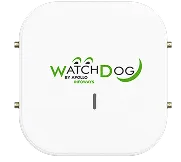
Front View
- Dual-radio Wi-Fi 6 (802.11ax)
- 4×4 MIMO on 5 GHz + 4×4 MIMO on 2.4 GHz
- Maximum wireless speed: 5.375 Gbps

WD-AP880 is a Wi-Fi 6 product that complies with the 802.11ax standard. Whether for on-premises, cloud, or hybrid deployment models, they can all seamlessly integrate into the existing network infrastructure.
The access point has dual-radio 8 streams with external antenna, including 4×4 5 GHz and 4×4 2.4 GHz, achieving speeds up to 5.375 Gbps. It features a 2.5GE electrical port and a 1GE PSE port, with PoE-out for external power supply and IoT expansion. Supports both wall-mounted and ceiling-mounted installation, ideal for high-density scenarios such as venues and warehouses.
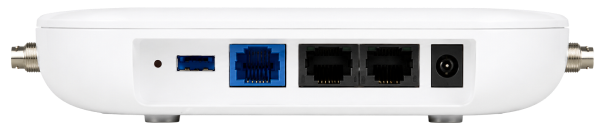
WD Wi-Fi 6 series APs support three flexible AP modes, which can operate independently or work in collaboration with wireless controllers. They can be freely switched according to actual deployment needs, adapting to different network architectures. Meanwhile, they are paired with WD’s cloud-based deployment platform and WD-NMC on-premises deployment platform—both platforms are equipped with capabilities for intelligent automated management, AI-driven insights, and unified infrastructure management and control. Leveraging these two flexible deployment options, users can easily enable full-lifecycle management of Wi-Fi 6 APs, maximizing the efficiency of intelligent O&M (Operations and Maintenance). This thus ultimately meets the diverse application scenario needs of various enterprises.
WD Wi-Fi 6 series APs can work in cloud AP mode, and can also collaborate with wireless controllers (ACs). If combined with the WD cloud platform, enterprises can achieve unified monitoring and management of wired and wireless networks, and obtain an integrated operation and maintenance experience. The Cloud platform is equipped with an intuitive interactive Web interface and advanced, scalable management tools. It adopts a fully distributed architecture, enabling comprehensive management of network, terminal, user, and service activation functions.
WD Wi-Fi 6 series APs can work in cloud AP mode, and can also collaborate with wireless controllers (ACs). If combined with the WD WD-NMC platform, enterprises can achieve unified monitoring and management of wired and wireless networks, and obtain an integrated operation and maintenance experience. The WD-NMC platform is equipped with an intuitive, user-friendly web interface, supports network control, and provides a unified view of the network topology while enabling policy-based network management.
WD Wi-Fi 6 series APs support operation in FitAP mode and work in collaboration with wireless controllers, switches, routers and security products with embedded wireless controllers. This enables them to adapt to scenarios of different scales, simplify O&M (Operations and Maintenance) to reduce costs, enhance network performance and security, support flexible business expansion, and ultimately achieve on-demand deployment while protecting customers' early-stage investments
802.11ax uses OFDMA to allow multiple users to transmit data simultaneously. OFDMA splits a channel into sub - channels, known as resource units (RUs), with specific subcarriers, and assigns RUs to different users for simultaneous transmission. OFDMA enables simultaneous multi-user transmission and reduces latency caused by channel contention.
DL/UL MU-MIMO technology allows AP to send data to multiple stations simultaneously, breaking through the traditional wireless serial communication mechanism, increasing the utilization rate of wireless spectrum resources, and improving the number of effective access users and access experience under high -density deployment.
Spatial reuse allows the access points and their clients to differentiate between BSSs, assigns a different color per BSS to help access point identify co-channel interference and stop transmission in time. This optimizes frequency reuse and improves network capacity.
TWT improves power efficiency and reduces contention by increasing client sleep time and allowing negotiation of the times that clients can access the medium.
| Item | Specification |
|---|---|
| Weight | 1.05Kg |
| Dimensions (W × D × H) | 185 mm × 185 mm × 35 mm (without mounting brackets) |
| Interface | 1 x 100/1000M/2.5G Ethernet, RJ-45, PoE input 1 x 100/1000M Ethernet, RJ-45, PoE output |
| Console port | 1 x Management console port (RJ-45) |
| USB port | 1 x USB 2.0 at 2.5W |
| PoE input | 1 x 100/1000M/2.5G Ethernet, 802.3at/af |
| PoE output | 1 x 100/1000M Ethernet, 802.3af |
| Local power supply | 54V DC (center-positive circular plug) power adapter (sold separately) |
| Antenna type | External antenna (sold separately) |
| Antenna Gain | The Antenna Gains are dependent on External antenna |
| Built-in IoT module | BLE5.1 |
| Frequency bands | 2.400 to 2.4835GHz ISM 5.150 to 5.250GHz U-NII-1 5.250 to 5.350GHz U-NII-2A 5.470 to 5.725GHz U-NII-2C 5.725 to 5.850GHz U-NII-3/ISM Note: The available bands and channels are dependent on the configured regulatory domain (country) |
| Modulation technology | 802.11b: Direct-sequence spread spectrum (DSSS) 802.11a/g/n/ac: Orthogonal frequency-division multiplexing (OFDM) 802.11ax: Orthogonal frequency-division multiple access (OFDMA) |
| Modulation mode | 11b: BPSK, QPSK, CCK 11a/g/n: BPSK, QPSK, 16QAM, 64QAM 11ac: BPSK, QPSK, 16QAM, 64QAM, 256QAM 11ax: BPSK, QPSK, 16QAM, 64QAM, 256QAM, 1024QAM |
| Data rates (Mbps) | 802.11b: 1, 2, 5.5, 11 802.11a/g: 6, 9, 12, 18, 24, 36, 48, 54 802.11n: 6.5 to 600 (NSS = 1 to 4, HT20 to HT40) 802.11ac: 6.5 to 6,933 (MCS0 to MCS9, NSS = 1 to 8, VHT20 to VHT160) 802.11ax: 7.3 to 9,608 (MCS0 to MCS11, NSS = 1 to 8, HE20 to HE160) |
| Maximum transmit power | 5GHz: 26 dBm 2.4GHz: 23 dBm Note: Transmit power is multi-chain combined power, no antenna gain is included. |
| Adjustable power granularity | Configurable in increments of 1dBm |
| Reset button | Restoration to factory default, AP mode control |
| Kensington | Kensington security slot |
| Installation | Wall mounting/ceiling mounting, the mounting bracket has been preinstalled on the back of the AP |
| Indicators (LED) | Yellow/green/blue status LEDs for different working states indicate boot loader status, association status, operating status, and fault states of the system |
| Temperature | Operating temperature: +0°C to +50°C Storage temperature: –40°C to +70°C |
| Humidity | Operating humidity: 5% to 95% (non-condensing) Storage humidity: 5% to 95% (non-condensing) |
| Protection class | IP41 |
| Surge protection | Common Mode: 4KV |
| Overall power consumption | 20.1W (including USB) 17.6W (excluding USB) |
| Safety standards | IEC/EN 62368-1 |
| EMC standards | EN 301 489-1 EN 301 489-3 EN 301 489-17 EN 60601-1-2 EN 55032 EN 55035 CISPR 32 CISPR 35 IEC/EN 61000-4-2 IEC/EN 61000-4-3 IEC/EN 61000-4-4 IEC/EN 61000-4-5 IEC/EN 61000-4-6 IEC/EN 61000-4-8 IEC/EN 61000-4-11 IEC/EN 61000-3-2 IEC/EN 61000-3-3 |
| Radio standards | ETSI EN 300 328 ETSI EN 301 893 ETSI EN 300 440 FCC Part 15E |
| RoHS standards | DIRECTIVE 2011/65/EU (EU) 2015/863 |
| Health standards | EN 50385:2017 EN IEC 62311:2020 |
| MTBF (25°C) | 1859450 hours |