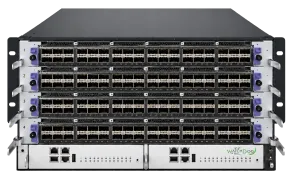
WD25004X
- Compact 6U modular switch
- Leaf, RR, Aggregation, Secure Edge

The WD25000X Data Center Cloud Core Series is a high-capacity switching platform designed for large cloud and modern data centre networks. It features a CLOS+ multi-grade architecture with independent engines for control, detection and maintenance, ensuring high availability and rapid failover. The system supports high-density 40G/100G/400G interfaces and delivers up to 9.6 Tbps per slot for scalable spine and core designs.
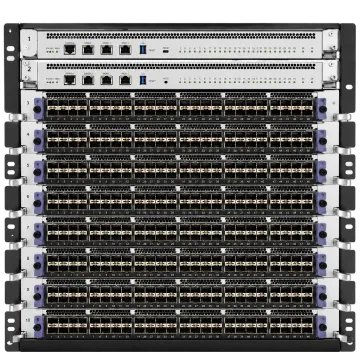
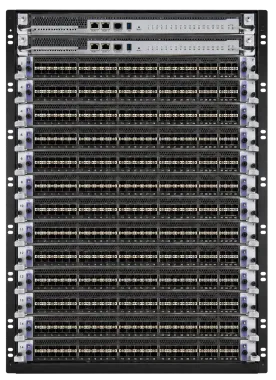
The WD25000G Data Center Intelligent Core Switch Series switches feature a multi-grade, multi-plane architecture with a midplane-free design, enabling seamless and continuous bandwidth upgrades. They support industry -leading 48- port 40GE/100GE, 36-port 40GE/100GE, 8-port 400G interfaces to meet both current and future data center application demands. By adopting independent switching fabric modules and dedicated MPU engines, the platform significantly enhances system availability while ensuring smooth and scalable bandwidth expansion.
VSS can virtualize up to two WD25000X switches into a single logical VSS fabric, delivering enhanced resiliency, scalability, and operational simplicity. High Availability is ensured through patented hot-standby technology that provides real-time data backup and non-stop forwarding across both the control plane and data plane, eliminating single points of failure and maintaining continuous service delivery. The distributed architecture supports multi-chassis link aggregation, enabling efficient load sharing and seamless backup across multiple uplinks to improve redundancy and link utilization. In addition, VSS simplifies network operations by presenting the entire fabric as a single managed entity with one IP address, streamlining device and topology management, improving operational efficiency, and reducing overall network maintenance costs.
MDC partitions a single chassis into multiple secure logical switches, enabling multi-tenant isolation and optimized resource utilization. This architecture lowers network TCO and supports flexible service deployment across different data center environments. MDC helps reduce operational overhead, simplifies deployment of differentiated services, and allows cloud providers to scale network capabilities without additional physical devices.
VXLAN (Virtual Extensible LAN) uses MAC-in-UDP encapsulation, in which the original Layer 2 packet is wrapped with a VXLAN header and transported within a UDP/IP packet. This mechanism enables Layer 2 networks to be extended over a Layer 3 infrastructure, delivering significantly higher scalability for Layer 2 segmentation while ensuring more efficient utilization of available network paths. MP-BGP EVPN (Multi-Protocol BGP Ethernet Virtual Private Network) serves as the control plane for VXLAN overlay networks by leveraging standards-based BGP. It enables automatic VTEP peer discovery and efficient distribution of end-host reachability information, eliminating unnecessary traffic flooding and reducing full-mesh requirements through the use of BGP route reflectors. MP-BGP EVPN also supports optimal, flow-based end-to-end load sharing for improved performance and scalability. In addition, the platform provides large table capacities for ARP/ND, MAC, and ACL entries, ensuring reliable operation and scalability in large-scale data center environments.
| Features | WD25004X | WD25008X | WD25016X |
|---|---|---|---|
| MPU Slots | 2 | 2 | 2 |
| MPU Models | WDGM1SUP04B1 WDGM1SUP04H1 |
WDGM1SUPB1 WDGM1SUPH1 |
WDGM1SUPB1 WDGM1SUPH |
| MPU SDRAM | 8 GB 16 GB |
8 GB 16 GB |
8 GB 16 GB |
| MPU Flash | 1 GB | 1 GB | 1 GB |
| MPU USB Port | 1 | 1 | 1 |
| MPU MGMT Ports | 2×10/100/1000M Base-T, 2×1G SFP | 2×10/100/1000M Base-T, 2×1G SFP 1×10/100/1000M Base-T, 1×1G SFP |
2×10/100/1000M Base-T, 2×1G SFP 1×10/100/1000M Base-T, 1×1G SFP |
| MPU Console Port | 1 | 1 | 1 |
| Switching Fabric Module Slots | 6 | 6 | 6 |
| Port Switching Capacity | 57.6 Tbps / 387 Tbps | 115.2 Tbps / 516 Tbps | 230.4 Tbps / 1032 Tbps |
| Weight (Full Configuration) | ≤ 110 kg / ≤ 242.5 lb | ≤ 190 kg / ≤ 418.9 lb | ≤ 352 kg / ≤ 776.6 lb |
| CPU | Quad Core 1.2 GHz | Quad Core 1.2 GHz | Quad Core 1.2 GHz |
| Forwarding Capacity | 28800 Mpps | 57600 Mpps | 115200 Mpps |
| LPU Slots | 4 | 8 | 16 |
| Maximum Power Consumption | 4800 W | 9600 W | 19200 W |
| Dimension (WxDxH) |
264 x 440 x 857 mm (6U) 10.4 x 17.3 x 33.7 in |
531 x 440 x 857 mm (12U) 20.9 x 17.3 x 33.7 in |
931 x 440 x 857 mm (21U) 36.7 x 17.3 x 33.7 in |
| Operating Temperature | -5°C to 55°C | ||
| Storage Temperature | -40°C to 85°C (-40°F to 185°F) | ||
| Humidity | 5% to 95% (non-condensing) | ||
| Redundancy | Redundant MPUs, switching fabric modules, power modules, and fan trays | ||