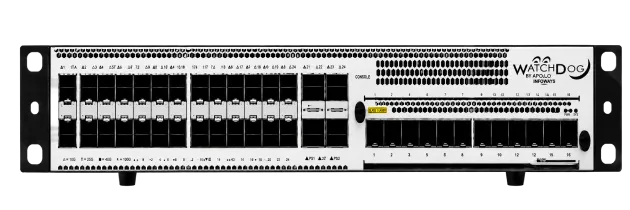
WD16000-M1A
- Switching Capacity: 640 Gbps
- Rack Size: 1 RU — Fixed-port router
- Power: Dual independent AC/DC/HVDC supply

WatchDog WD16000-M routers are next-generation cloud service routers designed for modern digital network infrastructures and are ideal for deployment across government, finance, transportation, power utilities, healthcare, education, and telecom operator environments. Built with advanced high-availability architecture and programmable network processing capabilities, these routers deliver powerful service processing, exceptional reliability, and high-performance data forwarding for mission-critical applications.
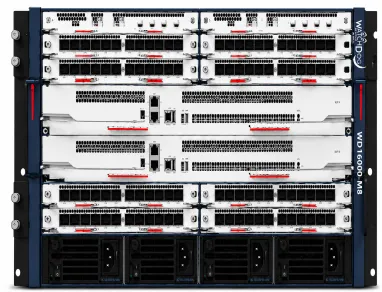
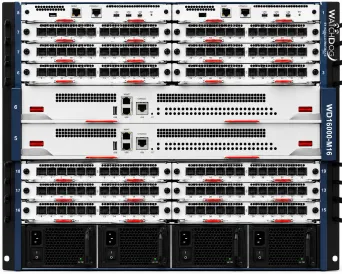
The router supports advanced technologies such as SRv6, enabling one-hop cloud access and simplifying service provisioning across the network. It also supports iFIT and Telemetry for real-time service status reporting and granular network monitoring, helping organizations achieve refined management and reliable service assurance. In addition, the router supports SD-WAN carrier and branch network solutions, allowing intelligent traffic scheduling, refined network management, and accurate prediction of network trends through service emulation and failure testing. To further enhance multi-service deployment, it supports advanced network slicing technologies including FlexE, channelized sub-interfaces, and Flex-Algo. By implementing network slices across the physical, network, and transport layers, the router can isolate services for different tenants in the cloud while ensuring dedicated SLA assurance for each service type.
Designed with a carrier-grade hardware architecture, the router ensures physical isolation between the control, service, and switching planes, delivering enhanced reliability and stability through independent switching fabric modules. It supports 1+1 redundancy for both the MPU and switching fabric modules, ensuring continuous operation and minimizing service interruption in case of hardware failure. The system also features an efficient front-to-rear airflow design along with redundant fan trays that provide a total of 12 fans for optimized thermal management and high availability. To further strengthen reliability, the router supports N+M power redundancy with built-in AC and DC power modules, enabling uninterrupted power delivery. In addition, it supports advanced high-availability protocols such as BFD for BGP, IS-IS, RIP, OSPF, and static routing, along with NSR and GR switchover capabilities for fast fault recovery and seamless network convergence.
The router is designed with a highly efficient thermal architecture that adopts a front-to-rear airflow system, improving heat dissipation efficiency by up to 40%. Its fan tray micro-modularization design ensures that the average module temperature remains approximately 5 °C (41 ° F) lower compared to traditional cooling methods, while integrated air deflectors provide stable and optimized airflow across the chassis. To further enhance operational efficiency, the router supports advanced energy-saving technologies such as low-power mode configuration through SerDes, cutting-edge DDR controllers, on-demand core startup, and flexible processor frequency adjustment. Compared to the previous generation, the network processors (NPs) used in the WD16000-M series reduce overall power consumption by up to 41%. The system also features intelligent power module management with sequential module power-on capability, helping extend hardware lifespan and reduce electromagnetic interference (EMI). In addition, the router supports automatic fan speed adjustment with real-time fan tray monitoring and fault alarms, enabling dynamic cooling optimization based on ambient temperature and module configuration to minimize both power consumption and operating noise.
| Features | WD16000-M1A | WD16000-M8 | WD16000-M16 |
|---|---|---|---|
| Switching Capacity | 640Gbps | 800Gbps | 800Gbps |
| Chassis | Integrated chassis, which can be installed in a 19-inch rack | ||
| Ports | FE, GE, 10GE (LAN/WAN), 25GE, 100GE, 155M STM-1, 622M STM-1, 2.5G STM-1, STM-4, CWDM, ATM, and E1/T1 ports
Interface type changing between 100GE and 40GE Interface type changing between 155M STM-1, 622M STM-1, and GE Interface type changing between ATM/ and STM-1 |
||
| MPU Slots | Fixed-port router | 2 | 2 |
| Line Cards | Fixed port + 1 flexible card | 8 | 16 |
| Independent Switching Fabric Modules | Fixed-port router | 2 | 2 |
| Independent Fan Trays | Three independent fan trays in redundancy | Independent fan trays in redundancy | Independent fan trays in redundancy |
| Cooling | Front-to-rear airflow | Front-to-rear airflow | Front-to-rear airflow |
| MTBF | 35 years | 35 years | 35 years |
| MTTR | 0.5 hours | 0.5 hours | 0.5 hours |
| Dimensions (H x W x D) | 44 x 440 x 435 mm 1.73 x 17.32 x 17.13 In |
267 x 440 x 440 mm 10.51 x 17.32 x 17.32 In |
356 x 440 x 440 mm 14.02 x 17.32 x 17.32 In |
| Rack Size | 1 RU | 6 RU | 8 RU |
| Power System | Two independent power supplies in redundancy, supporting AC/DC/HVDC | Four built-in AC and DC power modules (N+M redundancy), without occupying any service module slot. | Four built-in AC and DC power modules (N+M redundancy), without occupying any service module slot. |
| Operating Temperature | -5°C to 55°C (23°F to 131°F) | ||
| Storage Temperature | –40°C to +85°C (–40°F to +185°F) | ||
| Operating temperature change | ≤ 30°C (86°F) per hour | ||
| Relative humidity | Operating humidity: 10% to 95% RH, non-condensing Storage humidity: 5% to 95% RH, non-condensing |
||
| Altitude | ≤ 5000 m (16404.20 ft) | ||