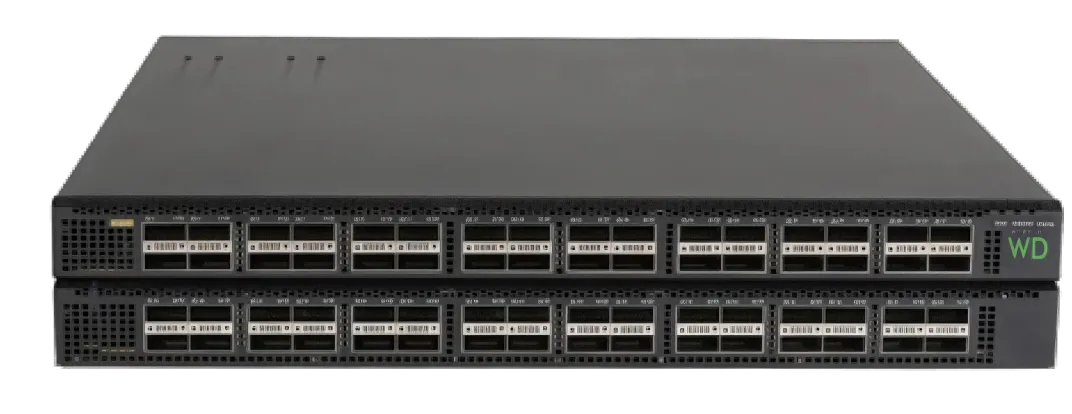
WD9850-64H
- Service slots, each with 64 × 100G QSFP28 ports
- 3 × fan tray slots for cooling
- 1 × mini-USB console port
- 1 × USB port
- Power Modules: Uses 650W AC/DC

The WD9850 Series switches represent the next generation of high-performance, high-density Ethernet switches designed specifically for modern data centre. Built to support the growing demands of enterprise and cloud networks, they deliver the performance, scalability, and flexibility required for high-capacity data centre deployments. The series offers flexible deployment options with highdensity 400GE, 100GE, 40GE, 25GE, and 10GE Ethernet ports, enabling large-scale server connectivity and seamless network expansion.
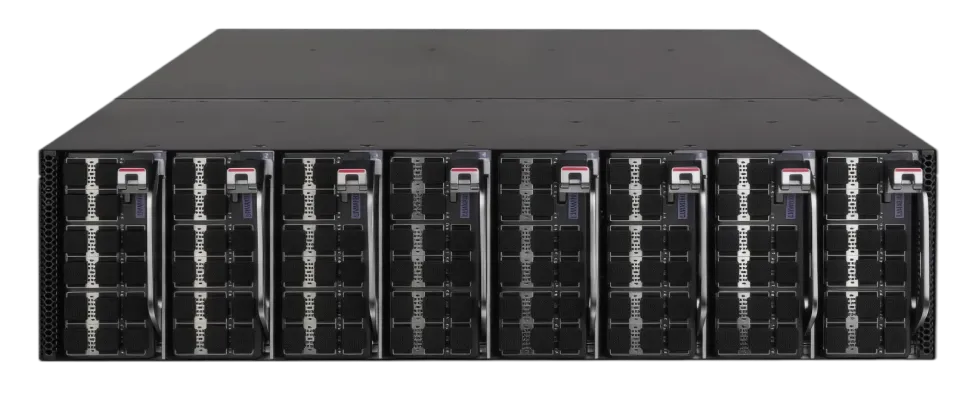
The WD 9850 series switches are designed with high-density 100GE, 40GE, 25GE, and 10GE ports, delivering powerful forwarding performance and flexible sub-card configurations. They can support up to 32 400GE ports or 128 100GE ports, providing exceptionally high port density and robust forwarding capabilities. This makes the series well-suited to meet the converged access networking requirements of high-end data centers with high-density server deployments.
WD9850 series switch supports a comprehensive set of data center features designed to meet the demands of modern high-performance networks. It supports MP-BGP EVPN (Multiprotocol Border Gateway Protocol Ethernet Virtual Private Network), which can operate as the VXLAN control plane to simplify VXLAN deployment, eliminate unnecessary traffic flooding, and reduce full-mesh requirements between VTEPs through the use of BGP route reflectors. The switch also supports Fibre Channel over Ethernet (FCoE), allowing storage, data, and computing traffic to be transmitted over a single converged network, thereby reducing network construction complexity as well as operational and maintenance costs. In addition, support for Priority-based Flow Control (PFC), Enhanced Transmission Selection (ETS), and Data Center Bridging Exchange (DCBX) ensures low latency and lossless transmission for Fibre Channel storage, RDMA applications, and high-performance computing services.
The WD9850 series switches support M-LAG, allowing links from multiple switches to be aggregated into a single logical connection to provide device-level link redundancy. This capability is particularly suitable for servers that are dual-homed to a pair of access switches, ensuring node-level resilience. By virtualizing two physical devices into one logical device, M-LAG simplifies network topology design and spanning tree configuration. It also enables independent, in-service upgrades, allowing DR member devices to be upgraded one at a time with minimal impact on traffic forwarding. In addition, the DR system uses a dedicated keepalive link to detect multi-active conditions, ensuring that only one-member device forwards traffic in the event of a DR split, thereby maintaining high availability and network stability.
Remote Direct Memory Access (RDMA) enables user application data to be transmitted directly to the storage space of servers, allowing high-speed data transfer from a local system to the storage of a remote system over the network. By eliminating multiple data copies and context-switching operations during transmission, RDMA significantly reduces CPU utilization and improves overall system performance. To support RDMA over standard Ethernet infrastructures, the WD9850 series switches provide full support for RoCE (RDMA over Converged Ethernet) and can be used to build a lossless Ethernet network that ensures zero packet loss. RoCE operation on the WD9850 switches is enabled through key technologies such as Priority-based Flow Control (PFC), Explicit Congestion Notification (ECN), Data Center Bridging Exchange (DCBX), and Enhanced Transmission Selection (ETS), ensuring reliable, low- latency, and high-performance data transport.
| Features | WD9850-64H | WD9850-8C |
|---|---|---|
| Flash | 4GB | |
| SDRAM | 8GB | |
| Latency | <850 ns | |
| Switching Capacity | 12.8Tbps | 25.6Tbps |
| Forwarding capacity | 4400 Mpps | 7655.5Mpps |
| Buffer | 42M | 64M |
| Console Port | 1 | 1 |
| Out-of-Band Management Port | One GE copper port and one GE fiber port | |
| USB Port | 1 | 1 |
| Mini USB Port | 1 | 1 |
| QSFP28/QSFP+ port | 64 | N/A |
| Expansion Slot | NA | 8 (16 100G ports or 4 400G ports per slot) |
| Power Module Slot | 4 | |
| Fan Tray Slot | 3 | 5 |
| Air Flow Direction | From front to rear or from rear to front | Front-to-rear (from the port side to the power supply side) |
| AC input voltage | 90 VAC to 264 V AC | 90-290 V AC |
| DC input voltage | -40 VDC to -72 VDC | N/A |
| Static Power Consumption | Dual AC: 336W | Dual AC: 305W |
| Typical Power Consumption | Dual AC: 519W | Dual AC: 921W |
| CPU | 2.2GHZ@4Cores | |
| Weight | ≤ 27kg (including three fan trays and four power supplies, excluding transceiver modules and cables) |
≤ 45kg |
| Dimensions (H×W×D) | 88.1× 440 × 540 mm (3.44 × 17.32 × 21.26 in) |
130.5 × 440 × 760 mm (5.14 × 17.32 × 29.92 in) |
| Operating Temperature | -5°C to 55°C (23°F to 131°F) | |
| Operating Humidity | 5% to 95%, noncondensing | |
| MTBF (Year) | 25.31 | |
| MTTR(Hour) | 1 | |