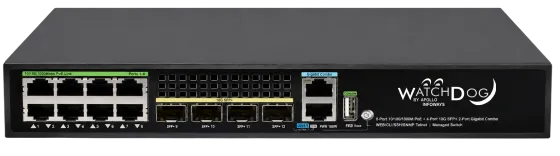
WD-GS-8G4XS
- 8*10/100/1000BASE-T Ports,
- 4*1G/10GBASE-X SFP+ Ports, (AC)

The WatchDog Enhanced Series Switch delivers a simple, fixed-power, and cost-effective access switching solution designed for fast deployment and reliable performance. Engineered to support modern enterprise needs, the switch combines enhanced security, high-density GE uplinks, and advanced Layer 3 capabilities including Static Routing, RIP, and OSPF. With built-in SDN and VSS support, it offers exceptional scalability and centralized network control.
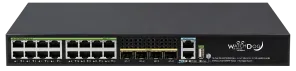
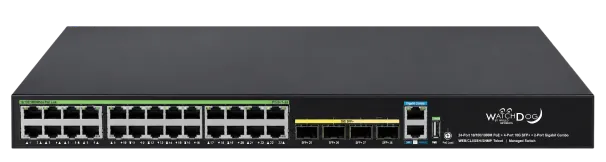
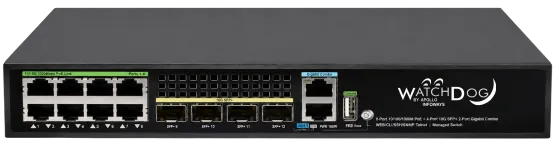
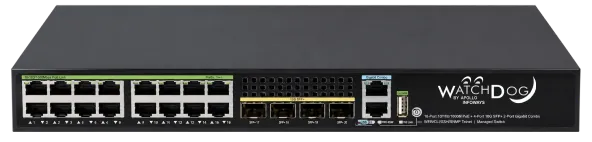
Software-Defined Networking (SDN) is an advanced network architecture that enhances network management efficiency and reduces operational complexity by separating the control plane from the forwarding plane using OpenFlow. It enables flexible traffic management and provides a robust, well-defined platform for core network applications and innovation WD Enhanced Series Switches support a large network flow table, making them ideal for modern SDN deployments. When integrated with the WD AD-Campus Platform, these switches enable the implementation of a simplified twolayer network architecture. This allows seamless addition of new functionalities to existing networks, significantly reducing management complexity while lowering overall maintenance costs
With support for up to nine switches operating as a single logical unit, VSS greatly enhances scalability and simplifies network management. It provides 1: N redundancy, cross-device link aggregation, load balancing, and uninterrupted service during failover events—ideal for high-availability environments
Advanced security functions help protect the network at both access and core layers. Features include multiauthentication modes (802.1X, MAC, Web), encrypted management via SSH v2, ARP and DHCP protection mechanisms, and integrated Endpoint Access Defense (EAD) for centralized enforcement of endpoint security policies.
The system delivers reliable and stable performance through comprehensive hardware and software redundancy mechanisms. It incorporates thermal protection and surge resistance to safeguard the device under harsh operating conditions, while Smart Link backup switching and LACP-based link redundancy ensure continuous network connectivity. In addition, support for industry-standard STP, RSTP, and MSTP protocols provides robust loop prevention and fast network recovery, ensuring high availability and dependable network operation.
| Features | WD-GS-8G4XS | WD-GS-8P4XS | WD-GS-16G4X | WD-GS-16P4X | WD-GS-24G4O | WD-GS-48G4OS | WD-GS-48P4O |
|---|---|---|---|---|---|---|---|
| Port Switching Capacity | 96 Gbps | 96 Gbps | 112 Gbps | 112 Gbps | 128 Gbps | 176 Gbps | 176 Gbps |
| Forwarding Capacity | 72 Mpps | 72 Mpps | 83 Mpps | 83 Mpps | 95 Mpps | 131 Mpps | 131 Mpps |
| System Switching Capacity | 336 Gbps | 336 Gbps | 336 Gbps | 336 Gbps | 336 Gbps | 336 Gbps | 336 Gbps |
| CPU | Dual-Core 1.2 GHz | Dual-Core 1.2 GHz | Dual-Core 1.2 GHz | Dual-Core 1.2 GHz | Dual-Core 1.2 GHz | Dual-Core 1.2 GHz | Dual-Core 1.2 GHz |
| SDRAM | 2GB or 4GB | 2GB or 4GB | 2GB or 4GB | 2GB or 4GB | 2GB or 4GB | 2GB or 4GB | 2GB or 4GB |
| Flash | 2GB or 16GB | 2GB or 16GB | 2GB or 16GB | 2GB or 16GB | 2GB or 16GB | 2GB or 16GB | 2GB or 16GB |
| GE Ports (RJ45) | 8 | 8 PoE+ | 16 | 16 PoE+ | 24 | 48 | 48 PoE+ |
| SFP Ports (1G/10G) | 4 | 4 | 4 | 4 | 4 | 4 | 4 |
| Console Port | 1 | 1 | 1 | 1 | 1 | 1 | 1 |
| MGMT Port | 1 | 1 | 1 | 1 | 1 | 1 | 1 |
| Max Stacking Bandwidth | 20 Gbps | 20 Gbps | 40 Gbps | 40 Gbps | 80 Gbps | 80 Gbps | 40 Gbps |
| Max Stacking Units | 9 | 9 | 9 | 9 | 9 | 9 | 9 |
| Input Voltage | AC 90-264V @ 50/60 Hz | ||||||
| Idle Power | 5W | 8W | 7W | 25W | 6W | 13W | 29W |
| Max Power | 16W | 150W (PoE 150W) | 19W | 317W (PoE 317W) | 19W | 30W | 512W (PoE 512W) |
| Fan | - | - | - | 1 Fan | - | - | 2 Fans |
| MTBF | 141 years | 92 years | 145 years | 112 years | 122 years | 114 years | 58 years |
| Dimension (W x D x H) | 266×161×44 mm | 266×161×44 mm | 440×160×44 mm | 440×260×44 mm | 440×160×44 mm | 440×160×44 mm | 440×260×44 mm |
| Weight | 1.1 kg | 1.5 kg | 1.8 kg | 3.6 kg | 2.0 kg | 3.6 kg | 4.1 kg |
| Operating Temp | -5°C to 55°C | -5°C to 55°C | -5°C to 55°C | -5°C to 55°C | -5°C to 55°C | -5°C to 55°C | -5°C to 55°C |
| Humidity | 5-95% | 5-95% | 5-95% | 5-95% | 5-95% | 5-95% | 5-95% |