Watchdog Enterprise

Watchdog Enterprise 25G Core Switch

WatchDog Enterprise 25G Core Switches offers cuttingedge networking performance with support for 25G Ethernet connections, designed to meet the needs of highdemand environments. With robust features such as high throughput, low latency, and advanced network management capabilities, it ensures reliable and scalable solutions for enterprise data centres, cloud environments, and high-performance computing networks. Whether for upgrading existing infrastructure or building new networks, these switches provide flexibility, efficiency, and exceptional connectivity for modern enterprises.
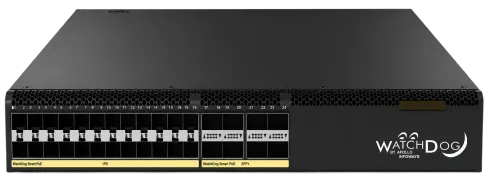
WD-GS-56XC switch

WD8000-28DC

  • 24×10GE/25GE SFP28 Ports,
  • 8×40GE/100GE QSFP28 Ports,
  • 5×fan tray slots,
  • 2×Power module slots.
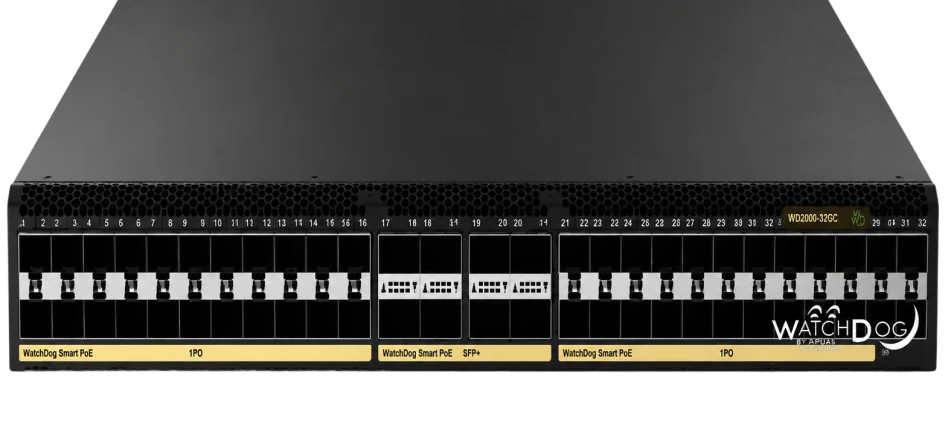
WD-GS-18QF switch

WD-GS-18QF

  • 48×10GE/25GE SFP28 Ports,
  • 8×40GE/100GE QSFP28Ports,
  • 5×fan tray slots,
  • 2×power module slots.

Key Features

High-density 10GE/25GE forwarding

The switch offers high-density 10GE/25GE forwarding. It provides powerful hardware forwarding capacity and abundant campus features. It provides up to 48/24*1GE/10GE/25GE autosensing SFP28 ports and 8*100G ports. The switch supports modular power modules and fan trays. By using different fan trays, the switch can provide field changeable a VSS lows.

Embedded Access Controller

WD Enterprise 25G Core Switches implements the WLAN function by installing an AC feature pack on the main control unit, thereby implementing both the wired function and the WLAN function on a single device. Embedded AC is a low-cost WLAN solution, save overall investment, improve forwarding capacity, realized a true unified wired and wireless solution in Campus. Max 2K AP supported on one single switche

WatchDog Virtual Switching System (VSS)

WatchDog VSS virtualizes multiple Advanced Aggregation switches into a single virtual switch, offering several key benefits. It enhances scalability by allowing easy device addition, providing a single management point, and supporting plug-and-play functionality with auto-software updates. VSS ensures high availability with redundant control and data planes, enabling non-stop Layer 3 forwarding and eliminating single points of failure. The system also supports redundancy and load balancing through distributed link aggregation, optimizing link usage and backup. Additionally, it offers flexibility and resiliency by using standard GE ports for VSS links, allowing bandwidth customization and supporting scalable topologies across racks or campuses.

Wide Range of Advanced Features

The switch offers a variety of advanced features to enhance network performance and flexibility. Its modular hardware and software design enable hot swapping and redundancy for hardware components like power modules and fan trays, while software modularity allows for on-demand feature installation or removal. This refined architecture minimizes packet processing delays. The switch also supports Software-Defined Networking (SDN), which separates the control plane from the forwarding plane, simplifying network management, reducing maintenance costs, and enabling flexible traffic handling.

Software

SOFTWARE SPECIFICATIONS

IP Services
  • ARP attack detection
  • ARP source suppression
  • DHCP (Dynamic Host Configuration Protocol)
  • DHCP Server/relay agent/client/snooping
  • DNS (Domain Name System)
  • DDNS (Dynamic Domain Name System)
  • mDNS (Multicast Domain Name System)
  • Static/Dynamic/Gratuitous/proxy ARP
  • ARP snooping/fast reply/direct route advertisement/ping
  • ND (Neighbor Discovery)
  • ND snooping/proxy/direct route advertisement/ping
  • DHCPv6 Server/relay agent/client/snooping/guard
  • GRE (Generic Routing Encapsulation)
  • GRE tunneling
  • VXLAN tunneling and VXLAN-DCI tunnelling
  • IPv4/IPv6 over IPv4 tunneling
  • IPv4/IPv6 over IPv6 tunneling
  • IPv4/IPv6 Fast Forwarding
  • IRDP (ICMP Router Discovery Protocol)
  • UDP helper
  • HTTP redirect
Layer 2 Technologies
  • VLAN ID range 0 to 4095(Total 4096, 0 and 4095 are reserved)
  • Access/Trunk/Hybrid VLAN
  • Port-based VLAN
  • MAC-based VLAN
  • IP subnet-based VLAN
  • Protocol-based VLAN
  • IEEE 802.1P(CoS priority)
  • BPDU/root/loop/TC-BPDU/PVST BPDU/dispute loopback guard
  • BPDU filter
  • Role/TC-BPDU transmission restriction
  • PVST (Per-VLAN Spanning Tree) compatible with PVST+/RPVST+/PVRST+
  • Super VLAN
  • Private VLAN
  • Voice VLAN
  • QinQ (802.1Q-in-802.1Q)
  • VLAN mapping
  • Static/Dynamic/Blackhole/Multiport unicast MAC
  • MAC automatic learning and aging
  • Port-based/VLAN-based MAC learning limit
  • MAC filter
  • L2PT (Layer 2 Protocol Tunneling)
  • Jumbo frame
  • Store-and-forward (Default)
  • Cut-through-forward
  • Broadcast/multicast/unknown unicast storm constrain
  • Port isolation
  • Loop detection (VLAN and VXLAN network)
  • MVRP (Multiple VLAN Registration Protocol)
  • GVRP (Generic VLAN Registration Protocol)
  • STP (Spanning tree protocol)
  • RSTP (Rapid Spanning Tree Protocol)
  • MSTP (Multiple Spanning Tree Protocol)
  • LLDP (Link Layer Discovery Protocol) and LLDP-MED
  • DCBX (Data Center Bridging Exchange Protocol)
Ethernet configuration
  • Static aggregation
  • Dynamic aggregation
  • 10GE/25G/40GE/100GE port aggregation Ethernet configuration
  • LACP (Link Aggregation Control Protocol)
  • S-MLAG
  • AutoMDIX
  • M-LAG (Multichassis Link Aggregation)
  • Duplex Auto/Full/Half
    Quality of Service (QoS)
    • ACL (Access Control List)
    • Advanced ACL User-defined
    • ACL Ingress and Egress ACL
    • Ingress/Egress CAR Diff-Serv QoS
    • Eight queues on a port 802.1P/DSCP
    • Priority marking and remarking
    • 802.1p, TOS, DSCP, and EXP priority mapping
    • Flexible queue scheduling algorithms including SP, WRR, SP+WRR, WFQ, SP+WRR
    • Traffic classification based on source MAC, destination MAC
    • Traffic shaping and Time ranges
    • Congestion avoidance, Tail-Drop, RED and WRED
    • Source IP, destination IP, port, protocol, and VLAN
      Security
      • RBAC (Role-based access control)
      • AAA (Authentication, Authorization, and Accounting)
      • RADIUS (Remote Authentication Dial-In User Service)
      • SSH1.x and SSH2.0 (Secure Shell)
      • SSL (Secure Sockets Layer)
      • HTTPS
      • Public Key Infrastructure (PKI)
      • Control Plane Protection (CoPP), Wireless Intrusion Prevention System (WIPS)
      • MACsec (Media Access Control Security) All ports AES256 MACsec
      • Micro segmentation
      • TACACS (Terminal Access Controller Access Control System) Security
      • WDTACACS (WD Terminal Access Controller Access Control System)
      • Attack detection and prevention
      • TCP attack prevention
      • IPSG (IP source guard)
      • IPv6 RA Guard
      • ARP attack protection
      • ND attack protection
      • Sticky MAC
      • EAD (Endpoint Admission Defense)
      • Port security
      • Triple authentication
      • 802.1X authentication
      • Portal authentication
      • MAC authentication
      • Web authentication
      • uRPF (Unicast Reverse Path Forwarding)
      • MFF (MAC-forced forwarding)
      • SAVI (Source Address Validation Improvement)
      • FIPS (Federal Information Processing Standards)
      • OSPF, RIPv2, BGPv4 plain text and MD5 authentication
      • Basic and advanced ACLs for packet filtering
      • Hierarchical user management and password protection
      VXLAN
      • VXLAN L2 switching
      • VXLAN L3 routing
      • Centralized VXLAN gateway
      • VXLAN
      • Distributed VXLAN gateway
      • VXLAN M-LAG and VXLAN-DCI
      • OVSDB (Open vSwitch Database)
      • VTEP MP-BGP
      • EVPN control plane
      • EVPN VXLAN
      • EVPN M-LAG
        Routing
        • Static routing, RIP, OSPF, IS-IS, and BGP
        • IPv4/IPv6 dual stack
        • IPv4/IPv6 ECMP (Equal-cost multi-path routing)
        • IPv4/IPv6 PBR (Policy-based routing)
        • IPv6 static routing, RIPng, OSPFv3, IS-ISv6, and BGP4+
        • Pingv6, Telnetv6, FTPv6, TFTPv6, DNSv6, ICMPv6
        • Dual-stack PBR
        • IPv4/IPv6 Routing policy
          Multicast
          • PIM-DM, PIM-SM, PIM-SSM
          • IPv6 PIM-DM, PIM-SM, PIM-SSM, and Any-RP
          • Any-RP
          • PIM snooping
          • MSDP (Multicast Source Discovery Protocol)
          • IGMP Snooping
          • IGMP snooping proxying
          • IGMP Filter and IGMP Fast leave
          • IGMPv1/IGMPv2/IGMPv3
          • IGMP proxying
          • IPv6 PIM snooping
          • MVPN (Multicast VPN)
          • Multicast policy and Multicast QoS
          • MLDv1
          • MLDV2
          • MLD proxying
          • MLD Snooping
          • MLD snooping proxying
          • Multicast routing and forwarding
          • Multicast VLAN
          Intelligent Lossless Network
          • PFC (Priority-based Flow Control)
          • ECN (Explicit Congestion Notification)
          • NVMe-oF (NVMe over Fabrics)
          • DCQCN
          • RoCEv2 (RDMA over Converged Ethernet v2)
            High Availability
            • CFD (Connectivity Fault Detection) (IEEE 802.1ag and ITU-T Y.1731)
            • DLDP (Device Link Detection Protocol)
            • RRPP (Rapid Ring Protection Protocol)
            • ERPS (G.8032 Ethernet Ring Protection Switching)
            • Smart Link Monitor Link
            • VRRPv2 (Virtual Router Redundancy Protocol)
            • VRRPv3
            • BFD (Bidirectional forwarding detection)
            • Hardware BFD
            • Link aggregation
            • VCT (virtual cable test)
            • ISSU (In-Service Software Upgrade)
            • Smart-Link
            • BFD for VRRP/BGP/IS-IS/OSPF/RSVP/static routing, with a failover detection time less than 50 milliseconds
            • Track
            • Process redundancy/placement
            • CPU protection
            • Hot patching
            • Secure boot
            • Ethernet OAM (IEEE 802.3ah)
            Stacking
            • VSS (fast convergence within 50ms)
            • Distributed device management
            • Distributed link aggregation
            • Local device stacking and remote device stacking
            • Stacking through standard Ethernet ports
            • LACP-, BFD-, and ARP-based multi-active detection (MAD)
            • VSS Automatic configuration
            • Server-based automatic configuration
            • USB-based automatic configuration
            • Distributed resilient routing
              OpenFlow
              • Multiple controllers (EQUAL, master/slave)
              • OpenFlow 1.3
              • Multiple tables flow
              • Group table
                Programmability and Automation
                • Auto DevOps by using Python, NETCONF, TCL, and Restful APIs for automated network programming
                • Ansible
                    MPLS
                    • Static LSP (label switched path)
                    • LDP (Label Distribution Protocol)
                    • IPv6 LDP
                    • Tunnel policies
                    • MPLS L3VPN
                    • MPLS Ping/Tracert
                    • MCE (Multi-VPN Instance Customer Edge)
                    • IPv6 MCE
                    • VRF
                    • MPLS
                    • L2VPN
                    • MPLS OAM
                    • SRv6
                      Network management
                      • NQA (Network quality analyzer)
                      • performance management through gRPC or NETCONF
                      • NTP (Network Time Protocol)
                      • PTP (Precision Time Protocol) IEEE 1588 version 2/IEEE 802.1AS/SMPTE ST 2059-2/AES67-2015
                      • CWMP (CPE WAN Management Protocol/TR-069)
                      • System logs
                      • Alarming based on severity
                      • Power, fan, and temperature alarming
                      • SmartMC (embedded Smart Graphical Management Center)
                      • SNMPv1/SNMPv2c/SNMPv3
                      • RMON (Remote Network Monitoring) and groups 1,2,3 and 9
                      • NETCONF/YANG (XML-based network management protocol)
                      • Restful/Restconf API
                      • EAA (Embedded Automation Architecture)
                      • Debugging information output
                      • Device status monitoring mechanism, including the CPU engine, backplane, chips, and other key components
                      • Configuration through CLI, Telnet, and console port
                      • Fault alarm and automatic fault recovery
                      • Port mirroring SPAN (Switch Port Analyzer)/RSPAN (Remote SPAN)
                      • Flow mirroring
                      • NetStream/IPv6 NetStream
                      • sFlow
                      • Information center
                      • VCF (Virtual Converged Framework)
                      • Loading and upgrading through XModem/FTP/TFTP/SFTP/USB
                      • Embedded AC, maximum support management 2K AP
                      • NMS network management system
                      • Support LLDP-MIB
                      • Support Entity MIB
                      • ZeroTouch Provisioning
                      Visualization
                      • gRPC (Google remote procedure call)
                      • INT (Inband Telemetry)
                      • Flow group
                          Hardware

                          Hardware Specifications

                          Features WI8000-28XC WI8000-52XC
                          CPU Quad core, 2GHz
                          SDRAM 4GB / 16GB (Premium)
                          Flash 4GB / 64GB (Premium)
                          Packet Buffer 512M
                          Box Switching capacity 4.8Tbps
                          Port Switching capacity 2.8Tbps 4Tbps
                          Packet forwarding rate 1800Mpps 2000Mpps
                          Dimensions (H x W x D) 44 x 484 x 400 mm (1.73 x 19.32 x 15.75 In) 44 x 484 x 400 mm (1.73 x 19.32 x 15.75 In)
                          Weight ≤ 7.3 kg ≤ 7.6 kg
                          Console ports 1
                          Management RJ45 ports 1
                          USB ports 1
                          SFP28 24 48
                          QSFP28 8 8
                          Power supply slots 2
                          Fan trays 5 hot swappable fan trays, invertible airflow
                          Input voltage range AC: Rated: 100 V AC to 240 V AC @ 50 Hz/60 Hz
                          Max: 90 V AC to 264 V AC @ 47 Hz to 63 Hz
                          HVDC: Rated voltage range: 240V DC & Max voltage range: 180V – 320V DC
                          DC: Rated voltage range: -48 to -50VDC
                          Power consumption MIN:
                          Single AC: 76W Dual AC: 83W

                          MAX:
                          Single AC: 188W Dual AC: 199W
                          MIN:
                          Single AC: 76W Dual AC: 83W

                          MAX:
                          Single AC: 273W Dual AC: 277W
                          Operating temperature -5°C to 55°C (23°F to 131°F)
                          -60m~5000m altitude: From 0m, the maximum operating temperature reduce by 0.33°C for every time 100 the altitude increases by 100m.
                          Storage temperature -40°C to 85°C (-40°F to 185°F)
                          Operating & storage humidity 5% RH to 95% RH, non-condensing
                          MTBF(Year) 61.4 58.44
                          MTTR(Hour) 1 1