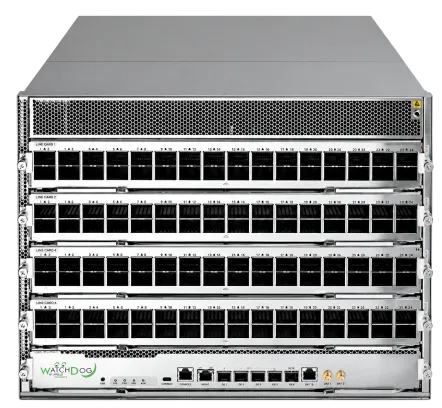
WD25000AI-128OE
- Console Port – RJ45 × 1
- Fan – 12
- USB Port – Type-C × 1

The WD25000AI Data Center Cloud Core Series is a high-capacity switching platform designed for large cloud and modern data centre networks. It features a CLOS+ multi-grade architecture with independen engines for control, detection and maintenance, ensuring high availability and rapid failover. The system supports high-density 40G/100G interfaces and deliver up to 9.6 Tbps per slot for scalable spine and core designs.
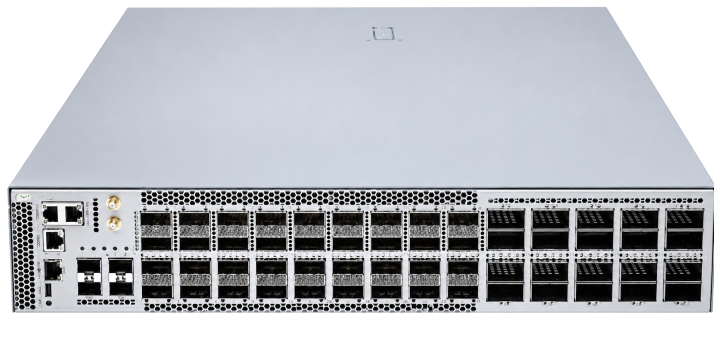
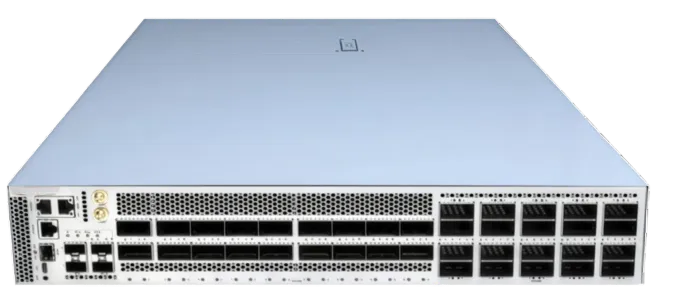
The WD25000AI switch delivers ultra-high-density 800GE and 400GE connectivity with exceptional forwarding performance. It supports network deployments of up to 9,216 × 400GE ports or 4,608 × 800GE ports, making it ideal for large-scale data centers and AI computing networks that require non-blocking, high-bandwidth server access.
Built on the innovative NCF-NCP architecture, the WD25000AI series offers outstanding scalability and flexibility for evolving data center environments. In this architecture, NCP (Network Computing Processor) units connect directly to servers and storage resources, while the NCF (Network Convergence Fabric) functions as a high-performance backbone that seamlessly interconnects all NCP units.
As computing and storage demands increase, additional NCF or NCP units can be integrated to expand network capacity in a linear and efficient manner. This modular design enables seamless scalability without requiring major architectural changes, service interruptions, or application modifications, ensuring smooth network growth alongside business requirements.
The WD25000AI utilizes WD-DDC (WatchDog Diversified Dynamic-Connectivity) technology, an innovative network architecture designed to enhance the flexibility and scalability of data center networks. Unlike traditional centralized chassis switch designs, WD-DDC adopts a distributed and decoupled architecture. By dividing conventional large network switches into smaller, independent modular components, known as box switches, network functions can be deployed in a decentralized manner. These box switches can function as line cards or switching fabric modules and can be distributed across multiple cabinets.
This approach improves heat dissipation and power consumption management while addressing limitations related to device upgrades and space expansion. At the same time, the architecture enables better decoupling of endpoint devices, such as NICs and GPUs, while maintaining high throughput and load efficiency.
In traditional Box Ethernet switch networks, traffic forwarding typically relies on routing protocols combined with ECMP (Equal-Cost Multi-Path) to achieve a degree of load-balanced traffic forwarding. However, factors such as flow quantity, flow size, and hash polarization can influence hash results. For example, when forwarding elephant flows, load imbalance may occur, which can negatively impact performance. In addition, the traditional ECMP approach is based on hop-by-hop route forwarding and cannot effectively detect the available bandwidth of forwarding paths. As a result, packet loss is more likely when congestion occurs.
Based on the WD-DDC architecture, the WD25000AI series adopts a cell-based switching mechanism. By dividing packets into uniformly sized cell units and forwarding them individually, traffic can be distributed evenly across NCPs, significantly improving forwarding efficiency. The WD-DDC architecture also supports path awareness through the VOQ (Virtual Output Queuing) mechanism. Before forwarding packets, NCPs determine whether path bandwidth is available and perform load balancing only across available paths, enabling non-blocking balanced switching. While the traditional ECMP method is susceptible to packet loss during link congestion, the WD-DDC cell-switching mechanism proactively detects available path bandwidth and enables non-blocking, balanced traffic forwarding.
| Features | WD25000AI-38OE | WD25000AI-36QDF20OE | WD25000AI-128OE |
|---|---|---|---|
| Switching capacity | 14.4T | 14.4T | 102.4T |
| Packet forwarding rate | 5.4Bpps | 5.4Bpps | - |
| Interfaces | 38*OSFP 800G |
36*QSFP-DD 400G+ 20*OSFP 800G |
128*OSFP 800G |
| Console port | RJ45 *1 | RJ45 *1 | RJ45 *1 |
| Out-of-band management port | RJ45 *1 | RJ45 *1 | RJ45 *1 |
| USB port | Type-C *1 | Type-C *1 | Type-C *1 |
|
Dimensions (mm) (H × W × D, with package) |
255×590×1135 | 255×590×1135 | 465×670×980 |
| Dimensions (H × W × D, no package) (mm) | 88.1×440×760 | 88.1×440×760 | 308.4×442×640 |
| Weight (no package) (kg) | 17.2kg | 17.3kg | 33.7kg |
| Weight (with package) (kg) | 21.59kg | 21.69kg | 65.94kg |
| Height (RU) | 2 | 2 | 7 |
| Power supply | 2 (1+1 Redundancy), AC | 2 (1+1 Redundancy), AC | 6 (3+3 Redundancy), AC |
| Fan | 4 | 4 | 12 |
| Typical Power Consumption |
660W (Ports using cables) 1192W (Ports using typical optical transceiver modules) |
694W (Ports using cables) 1233W (Ports using typical optical transceiver modules) |
1300W (Ports using cables) 3092W (Ports using typical optical transceiver modules) |
| Static Power Consumption | 322W | 322W | 680W |
| Maximum Power Consumption | 2135W | 2120W | 5640W |
| Typical Heat Dissipation | 2055.45 BTU/h | 2055.45 BTU/h | 3846.12 BTU/h |
| Maximum Heat Dissipation | 6302.15 BTU/h | 6131.54 BTU/h | 16296.19 BTU/h |
| MTBF (year) | 40 | 40 | 25 |
| MTTR (h) | 0.5 | 0.5 | 0.5 |
| Availability | 0.9999985 | 0.99999849 | 0.99999739 |
| DRAM Memory | 32G | 32G | 32G |
| NOR Flash | 32MB*2 | 32MB*2 | 32MB*2 |
| Nand Flash | 64GB | 64GB | 64GB |
| SSD |
240GB M.2 SATA (Optional) |
240GB M.2 SATA (Optional) |
240GB M.2 SATA (Optional) |
| Operating temperature | -5°C to 55°C | ||
| Storage temperature | -40°C to 80°C | ||
| Operating humidity | 5% to 95%, noncondensing | ||