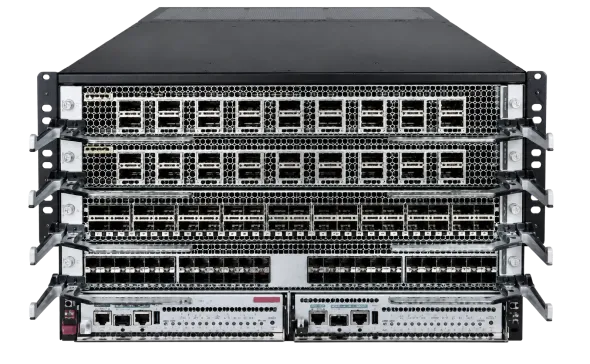
WD25004G
- MPU Models: WDXM1SUP04T2, WDGM1SUP04H1

The WD25000G Data Center Intelligent Core Switch Series is a high-capacity switching platform designed for large cloud and modern data centre networks. It features a CLOS+ multi-grade architecture with independent engines for control, detection and maintenance, ensuring high availability and rapid failover. The system supports high density 40G/100G/400G interfaces and delivers up to 9.6 Tbps per slot for scalable spine and core designs.
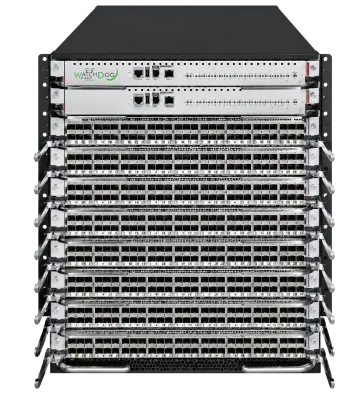
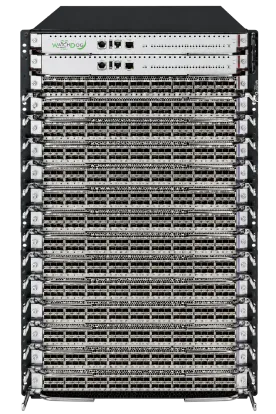
The WD25000G Data Center Intelligent Core Switch Series switches feature a multi-grade, multi-plane architecture with a midplane-free design, enabling seamless and continuous bandwidth upgrades. They support industry -leading 48- port 40GE/100GE, 36-port 40GE/100GE, 8-port 400G interfaces to meet both current and future data center application demands. By adopting independent switching fabric modules and dedicated MPU engines, the platform significantly enhances system availability while ensuring smooth and scalable bandwidth expansion.
WDMDC partitions a single chassis into multiple secure logical switches, enabling multi-tenant isolation and optimized resource utilization. This architecture lowers network TCO and supports flexible service deployment across different data center environments. WDMDC helps reduce operational overhead, simplifies deployment of differentiated services, and allows cloud providers to scale network capabilities without additional physical devices.
VXLAN (Virtual Extensible LAN) uses MAC-in-UDP encapsulation, in which the original Layer 2 packet is wrapped with a VXLAN header and transported within a UDP/IP packet. This mechanism enables Layer 2 networks to be extended over a Layer 3 infrastructure, delivering significantly higher scalability for Layer 2 segmentation while ensuring more efficient utilization of available network paths. MP-BGP EVPN (Multi-Protocol BGP Ethernet Virtual Private Network) serves as the control plane for VXLAN overlay networks by leveraging standards-based BGP. It enables automatic VTEP peer discovery and efficient distribution of end-host reachability information, eliminating unnecessary traffic flooding and reducing full-mesh requirements through the use of BGP route reflectors. MP-BGP EVPN also supports optimal, flow- based end-to-end load sharing for improved performance and scalability. In addition, the platform provides large table capacities for ARP/ND, MAC, and ACL entries, ensuring reliable operation and scalability in large-scale data center environments.
Remote Direct Memory Access (RDMA) enables direct transmission of application data from a local system to the memory or storage space of a remote server over the network, bypassing unnecessary CPU involvement. By eliminating multiple data copies and context-switching operations during data transfer, RDMA significantly reduces CPU load and delivers ultra-low latency with high throughput. RoCE (RDMA over Converged Ethernet) extends RDMA capabilities across standard Ethernet infrastructures. WatchDog switches support RoCE and enable the deployment of a lossless Ethernet network, ensuring zero packet loss for latency-sensitive workloads. RoCE incorporates key data center features such as Priority-based Flow Control (PFC), Explicit Congestion Notification (ECN), Data Center Bridging Capability Exchange (DCBX), and Enhanced Transmission Selection (ETS) to provide reliable, congestion-aware, and high-performance data transport.
| Features | WD25004G | WD25008G | WD25016G |
|---|---|---|---|
| Buffer | 32M (T series LPU) 36M (S series LPU) |
32M (T series LPU) 36M (S series LPU) |
32M (T series LPU) 36M (S series LPU) |
| MPU Slots | 2 | 2 | 2 |
| MPU Name | WDXM1SUP04T2 | WDXM2SUPT2 | WDXM2SUPT2 |
| MPU SDRAM | 16 GB | 16 GB | 16 GB |
| MPU Flash |
T series: 8 GB WDXM1SUPS2 used in the 25008G: 1G WDXM3SUPS2 used in the 25008G/S25016G:2G WDXM3SUP04S2 used in the 25004G:2G |
T series: 8 GB WDXM1SUPS2 used in the 25008G: 1G WDXM3SUPS2 used in the 25008G/S25016G:2G WDXM3SUP04S2 used in the 25004G:2G |
T series: 8 GB WDXM1SUPS2 used in the 25008G: 1G WDXM3SUPS2 used in the 25008G/S25016G:2G WDXM3SUP04S2 used in the 25004G:2G |
| MPU USB Port | 1 | 1 | 1 |
| MPU MGMT Ports | 2 | 2 | 2 |
| MPU Console Port | 1 | 1 | 1 |
| Switching Fabric Module Slots | 6 | 6 | 6 |
| Port Switching Capacity | 57.6 T / 387 Tbps | 115.2 T / 516 Tbps | 230.4 T / 1032 Tbps |
| Weight (Full Configuration) | ≤ 110 kg / ≤ 242.5 lb | ≤ 190 kg / ≤ 418.9 lb | ≤ 352 kg / ≤ 776.6 lb |
| CPU | Quad Core 2.2 GHz | Quad Core 2.2 GHz | Quad Core 2.2 GHz |
| Forwarding Capacity | 21600 Mpps | 43200 Mpps | 86400 Mpps |
| LPU Slots | 4 | 8 | 16 |
| Maximum Power Consumption | 5800 W | 12000 W | 22400 W |
| Dimension (WxDxH) |
264 x 440 x 857 mm (6U) 10.4 x 17.3 x 33.7 in |
531 x 440 x 857 mm (12U) 20.9 x 17.3 x 33.7 in |
931 x 440 x 857 mm (21U) 36.7 x 17.3 x 33.7 in |
| Operating Temperature | -5°C to 55°C | ||
| Storage Temperature | -40°C to 85°C (-40°F to 185°F) | ||
| Humidity | 5% to 95% (non-condensing) | ||
| Redundancy | Redundant MPUs, switching fabric modules, power modules, and fan trays | ||